Last Tuesday in Iowa, the message of change trumped experience. So what does the Clinton campaign do to mitigate the third-place finish in Iowa as it prepares for round-two in New Hampshire? Change the campaign’s message to change. In other words, if you can’t beat Obama’s message, co-opt his strategy and make it your own. But the question is: will it work in Hillary’s favor?
At a high school event in Penacook on Saturday, Sen. Clinton based her experience as “35 years of change” against Obama’s “fine-sounding” and high-minded “promise of change”. However, the problem strategically with Clinton’s new message of change is rather than looking forward, it inherently looks backward by ironically relying on the nostalgia of the past—particularly on her husband’s legacy—and not the hope for the future. What distinguishes Obama from Clinton is that he possesses the forward looking message of hope—one that Clinton can never co-opt.
Strategically, in the past two months, the Obama campaign has been successful in taking his message of hope and change to deflect his weaknesses as an inexperienced junior senator from Illinois. Capitalizing on the Bush Administration’s mishandling of the War in Iraq, coupled by the Jack Abramoff scandal that has tainted old-boy Washington politics, Obama’s claim as a new face in Washington, untainted by its corruption and politics, is consistent with the message of change and a new direction for the country.
The reason why Obama won in Iowa—and will yet again win in New Hampshire—is that he was able to unite voters from across the board. From different age groups and ethnicities to Independents and disgruntled Republicans alike, Iowans caucused for Obama because many believe in the change he is offering. Unfortunately, for the Clinton campaign, many voters view her as part of the old establishment and also part of the problem.
Will this new message of change work in Hillary’s favor? While it’s an interesting claim, voters will realize it’s too far-fetched. In Tuesday’s election, New Hampshire voters will not buy it.
Technorati Tags:
Hillary Clinton
Barack Obama
New Hampshire Primary
Sunday, January 06, 2008


Sunday, December 30, 2007
Iowa Caucus sets stage for 2008 Presidential Election
Ready, set, GO! This Thursday will mark the first Election Day of the 2008 Presidential Race. It’s actually pretty late considering that many of the candidates (from both political parties) declared their intentions to run for the White House earlier this year, i.e. Clinton and Obama had exploratory committees set up one year ago.
Yet with all the stump speeches, bus road trips, flights and kissing babies that these candidates have done over the past year, everything boils down to getting voters to show up and vote. Iowa, centered in America’s heartland, becomes the first litmus test to see if the thousands (some millions) of dollars the candidates spent will pay off.
Let’s see where the major frontrunners stand. First the Democrats:
Hillary Clinton. Political pundits and the media like to put her on the top of the polls because she has something that the other candidates in the field don’t have—and no, it’s not because she’s the only woman running for the presidency. She has name recognition and the backing of her popular husband, former President Bill Clinton. But, as we have seen in recent months, being a Clinton doesn’t guarantee an easy victory: David Geffen and other Hollywood moguls—once loyal Clintonites—now back Senator Barack Obama. Few in-house scandals within the Clinton campaign have cast some negativity that has reflected on her. All that being said, Robert Zimmerman, a Clinton campaign donor and member of the DNC said it best, “[t]he notion of front runner is obsolete in American politics.” In other words, there is no such thing as a lead when there haven’t been any votes to count.
Barack Obama. Let’s face it. What Obama has that other candidates in the field don’t have is outright superstar charisma. Sure, political pundits gripe about his lack of substance in policy issues; however his message of change and hope resonates with the electorate. Where does one find a candidate who can attract thousands of supporters during rallies? Barack Obama did it in Los Angeles, Austin and Oakland to name a few cities. He has won support from people inactive from politics and many have compared him to Robert Kennedy. Not bad for a junior senator from Illinois.
John Edwards. It’s easy to like John Edwards. His message of fighting for the little guy and progressive politics resonates with the American people. The tenacity of his wife, Elizabeth, suffering from cancer, and still campaigning for her husband, personifies sacrifice. The only problems for John Edwards are the two frontrunners ahead of him in Obama and Clinton.
X-Factor: While recent polls indicate that these three Democratic frontrunners are at a virtual tie, I predict that the x-factor in the Iowa Caucus will be the ones who actually turn out to caucus.
The bottom line is this: if more women show, the edge will have to go to Clinton. If the Obama campaign is successful in recruiting young people to caucus for him (especially those students who are from out-of state), I would have to give the edge to Obama. If the weather turns nasty, count on the Edwards’ loyal supporters to show up and cast their votes. If that turns out to be the case, Edwards can possibly pull off an upset victory.
Let’s look briefly at the Republicans.
There are essentially three Republican candidates vying for Iowa and one of them isn’t Rudy Giuliani. That’s because Giuliani decided to sit Iowa out and bet on the larger states like New York where he, no doubt, has the advantage. The strategy for Mitt Romney is to do the exact opposite: win the early states like Iowa and New Hampshire and hope to ride the momentum leading to the bigger states. The candidate who decided to cut Romney off is former Arkansas governor Mike Huckabee. With Huckabee essentially attacking Romney’s religion and character, Huckabee has methodically fought himself back to a dead-heat with Romney in Iowa. Both the Romney and Huckabee campaigns are coming to this final week trading blows and airing negative campaign ads. It’s too early to know how voters will react to these negative ads, but if Iowans react negatively to the negativity, that may swing voters to John McCain’s camp. Just like the Democrats, you may have the dark horse in McCain pulling off the victory in Iowa.
Politics is just like predicting the BCS in college football; rankings don't assure victory, the big game does. So it is with politics, Election Day is what matters most. We’ll find out Thursday.
Yet with all the stump speeches, bus road trips, flights and kissing babies that these candidates have done over the past year, everything boils down to getting voters to show up and vote. Iowa, centered in America’s heartland, becomes the first litmus test to see if the thousands (some millions) of dollars the candidates spent will pay off.
Let’s see where the major frontrunners stand. First the Democrats:
Hillary Clinton. Political pundits and the media like to put her on the top of the polls because she has something that the other candidates in the field don’t have—and no, it’s not because she’s the only woman running for the presidency. She has name recognition and the backing of her popular husband, former President Bill Clinton. But, as we have seen in recent months, being a Clinton doesn’t guarantee an easy victory: David Geffen and other Hollywood moguls—once loyal Clintonites—now back Senator Barack Obama. Few in-house scandals within the Clinton campaign have cast some negativity that has reflected on her. All that being said, Robert Zimmerman, a Clinton campaign donor and member of the DNC said it best, “[t]he notion of front runner is obsolete in American politics.” In other words, there is no such thing as a lead when there haven’t been any votes to count.
Barack Obama. Let’s face it. What Obama has that other candidates in the field don’t have is outright superstar charisma. Sure, political pundits gripe about his lack of substance in policy issues; however his message of change and hope resonates with the electorate. Where does one find a candidate who can attract thousands of supporters during rallies? Barack Obama did it in Los Angeles, Austin and Oakland to name a few cities. He has won support from people inactive from politics and many have compared him to Robert Kennedy. Not bad for a junior senator from Illinois.
John Edwards. It’s easy to like John Edwards. His message of fighting for the little guy and progressive politics resonates with the American people. The tenacity of his wife, Elizabeth, suffering from cancer, and still campaigning for her husband, personifies sacrifice. The only problems for John Edwards are the two frontrunners ahead of him in Obama and Clinton.
X-Factor: While recent polls indicate that these three Democratic frontrunners are at a virtual tie, I predict that the x-factor in the Iowa Caucus will be the ones who actually turn out to caucus.
The bottom line is this: if more women show, the edge will have to go to Clinton. If the Obama campaign is successful in recruiting young people to caucus for him (especially those students who are from out-of state), I would have to give the edge to Obama. If the weather turns nasty, count on the Edwards’ loyal supporters to show up and cast their votes. If that turns out to be the case, Edwards can possibly pull off an upset victory.
Let’s look briefly at the Republicans.
There are essentially three Republican candidates vying for Iowa and one of them isn’t Rudy Giuliani. That’s because Giuliani decided to sit Iowa out and bet on the larger states like New York where he, no doubt, has the advantage. The strategy for Mitt Romney is to do the exact opposite: win the early states like Iowa and New Hampshire and hope to ride the momentum leading to the bigger states. The candidate who decided to cut Romney off is former Arkansas governor Mike Huckabee. With Huckabee essentially attacking Romney’s religion and character, Huckabee has methodically fought himself back to a dead-heat with Romney in Iowa. Both the Romney and Huckabee campaigns are coming to this final week trading blows and airing negative campaign ads. It’s too early to know how voters will react to these negative ads, but if Iowans react negatively to the negativity, that may swing voters to John McCain’s camp. Just like the Democrats, you may have the dark horse in McCain pulling off the victory in Iowa.
Politics is just like predicting the BCS in college football; rankings don't assure victory, the big game does. So it is with politics, Election Day is what matters most. We’ll find out Thursday.
Saturday, March 24, 2007
Obama's a Different Type of Dude
Published in The Sacramento Bee, 19 February 2007
Forget the fact that his first name rhymes with Iraq, or his middle name is Hussein and his last name is one letter off from the name of the most wanted man in the world, but Senator Barack Obama, in my opinion, not only possesses the ability to win the Democratic nomination, but also has a legitimate chance to win the Oval Office in 2008.
Not because he’s black. In fact, race doesn’t have anything to do with it. Rather he understands the times better than other presidential candidates because he empathizes with the American people.
Critics may claim he’s inexperienced, his speeches are absent with substantive policy direction and are rhetorically-driven, but one cannot dismiss his strengths: his charisma that unites rather than divides the American people transcends day-to-day Washington politics; his belief that all Americans can achieve the American dream if they are willing to sacrifice is a message not heard since the days of Robert Kennedy.
What separates Mr. Obama from other contenders is his willingness to listen to the American people thereby successfully rallying them. It is an important lesson that the current administration has failed to understand in over three years.
Forget the fact that his first name rhymes with Iraq, or his middle name is Hussein and his last name is one letter off from the name of the most wanted man in the world, but Senator Barack Obama, in my opinion, not only possesses the ability to win the Democratic nomination, but also has a legitimate chance to win the Oval Office in 2008.
Not because he’s black. In fact, race doesn’t have anything to do with it. Rather he understands the times better than other presidential candidates because he empathizes with the American people.
Critics may claim he’s inexperienced, his speeches are absent with substantive policy direction and are rhetorically-driven, but one cannot dismiss his strengths: his charisma that unites rather than divides the American people transcends day-to-day Washington politics; his belief that all Americans can achieve the American dream if they are willing to sacrifice is a message not heard since the days of Robert Kennedy.
What separates Mr. Obama from other contenders is his willingness to listen to the American people thereby successfully rallying them. It is an important lesson that the current administration has failed to understand in over three years.
Wednesday, January 10, 2007
Is 21,000 US Troops enough to take out al-Sadr?
Former US Army general and supreme allied commander of NATO, Wesley Clark lambasted President Bush's plan to deploy an additional 21,000 troops to Iraq in the op-ed he wrote today titled in the Sacramento Bee as "Diplomacy as the Last Surge". But could the general have jumped the gun?
In the letter, General Clark argued that the president's plan is shortsighted and will only be a temporary fix, citing that "increased troop presence [will] initially frustrate...militias, [but] wouldn't be long before they found ways...to continue the conflict." Rather, General Clark suggested diplomacy as the key. General Clark identified the current situation in Iraq as a political and not a military problem.
As mentioned in my previous posts, the US must use diplomacy to help the Iraqis build a unitary government and they have done so since 2003 under Paul Bremmer III. If, however, the end to build that government involves choosing sides as I mentioned in my last post, then the military option cannot be ignored. The president's proposal of increasing troop levels—which he will address tonight—may mean that he is choosing Prime Minister al-Maliki's side. Let me explain in greater detail.
_________________________________________________
Supporting al-Maliki means eliminating al-Sadr. Translation: military action against al-Sadr is required.
_________________________________________________
The US, since 2003, has invested billions of dollars in helping the Iraqis form a unitary government, from setting up the Iraqi preliminary government to holding elections. Currently, the State Department is working with Iraqi officials in creating a fair system of dividing Iraq's oil reserves proportionally so as to include the minority Sunnis to the table. This would be an important step to build trust among the Kurds, Shias and Sunnis, and towards a unitary government. I believe the administration firmly believes that only through a unitary government will the current state of sectarian violence on the ground be curbed.
Forming a unitary government can only be done by bolstering al-Maliki’s political position in the Iraqi parliament. This is easier said than done since the Shia majority is also divided within as Muqtada al-Sadr and his faction wait along the sidelines to break away from the government. Supporting al-Maliki then means eliminating al-Sadr. Translation: military action against al-Sadr is required.
While the media has not reported it directly, CNN's military strategists have already circled in their fancy Google-Earth Iraqi map Sadr City as the next major area of confrontation where these 21,000 troops will be conducting military operations. This could only mean one thing. The US will attempt to root out Muqtada al-Sadr's heavily-armed Mahdi militia. If this military operation is successful, the US will not have only eliminated a group that it considered a threat to obstructing Iraq's plans in forming a unitary government but it will also eliminate al-Maliki's major political nemesis in the Iraqi parliament. As a result, eliminating al-Sadr would give al-Maliki major political leverage which I believe the administration is gambling on to happen. Success over al-Sadr would pave the way for al-Maliki to form an Iraqi unitary government. The question now stands: will 21,000 US troops be enough to take out al-Sadr? Will Pelosi, Ted Kennedy and the Dems put up the money for this deployment? Will the American people buy it? We will see.
Technorati Tags:
al-Maliki
Iraq
Muqtada al-Sadr
US Foreign Policy
Bush Administration
In the letter, General Clark argued that the president's plan is shortsighted and will only be a temporary fix, citing that "increased troop presence [will] initially frustrate...militias, [but] wouldn't be long before they found ways...to continue the conflict." Rather, General Clark suggested diplomacy as the key. General Clark identified the current situation in Iraq as a political and not a military problem.
As mentioned in my previous posts, the US must use diplomacy to help the Iraqis build a unitary government and they have done so since 2003 under Paul Bremmer III. If, however, the end to build that government involves choosing sides as I mentioned in my last post, then the military option cannot be ignored. The president's proposal of increasing troop levels—which he will address tonight—may mean that he is choosing Prime Minister al-Maliki's side. Let me explain in greater detail.
_________________________________________________
Supporting al-Maliki means eliminating al-Sadr. Translation: military action against al-Sadr is required.
_________________________________________________
The US, since 2003, has invested billions of dollars in helping the Iraqis form a unitary government, from setting up the Iraqi preliminary government to holding elections. Currently, the State Department is working with Iraqi officials in creating a fair system of dividing Iraq's oil reserves proportionally so as to include the minority Sunnis to the table. This would be an important step to build trust among the Kurds, Shias and Sunnis, and towards a unitary government. I believe the administration firmly believes that only through a unitary government will the current state of sectarian violence on the ground be curbed.
Forming a unitary government can only be done by bolstering al-Maliki’s political position in the Iraqi parliament. This is easier said than done since the Shia majority is also divided within as Muqtada al-Sadr and his faction wait along the sidelines to break away from the government. Supporting al-Maliki then means eliminating al-Sadr. Translation: military action against al-Sadr is required.
While the media has not reported it directly, CNN's military strategists have already circled in their fancy Google-Earth Iraqi map Sadr City as the next major area of confrontation where these 21,000 troops will be conducting military operations. This could only mean one thing. The US will attempt to root out Muqtada al-Sadr's heavily-armed Mahdi militia. If this military operation is successful, the US will not have only eliminated a group that it considered a threat to obstructing Iraq's plans in forming a unitary government but it will also eliminate al-Maliki's major political nemesis in the Iraqi parliament. As a result, eliminating al-Sadr would give al-Maliki major political leverage which I believe the administration is gambling on to happen. Success over al-Sadr would pave the way for al-Maliki to form an Iraqi unitary government. The question now stands: will 21,000 US troops be enough to take out al-Sadr? Will Pelosi, Ted Kennedy and the Dems put up the money for this deployment? Will the American people buy it? We will see.
Technorati Tags:
al-Maliki
Iraq
Muqtada al-Sadr
US Foreign Policy
Bush Administration
Thursday, January 04, 2007
Choosing Sides In Iraq
What is the difference between the Kurds, Shias, Sunnis and the Iraqi government? The difference is that the latter doesn't really exist (while the Bush Administration claims that it does) while the former sectarian groups are vying for political power through means of violence.
In other words, Iraq is truly in a state of civil war. Ivo H. Daalder, a senior correspondent from the Brookings Institution addressed the salient part of the issue when he posed this question on his blog: "[T]he questions for President Bush is this: Which side in Iraq's civil war are we going to back decisively?"
Answering this critical question will pave the way for a decisive new policy in Iraq. The current debates of whether we should increase troop levels and intensify military training for Iraqi soldiers will not address the current problem of sectarian violence, as the ISG had suggested, but will in fact exacerbate it. The fact is, as we train Iraqi police and soldiers (predominantly Shia) and transfer power to them, many exploit the training they received by attacking Sunni dominated areas of the country. The Sunni, to no surprise, retaliate using guerilla tactics, i.e. masquerading in Iraqi police uniforms and perform brutal mass executions of Shias. The stark reality is that our efforts to strengthen the Iraqi government have only exacerbated the sectarian violence in the region. In fact, the administration’s indecisiveness in answering the above question have placed our military in the middle of the violence, as Shias and Sunnis continue their tit-for-tat attacks making it more difficult for the already fragile Iraqi government to achieve unity.
Our response to the growing violence was to hold the Al-Maliki/Talabani government accountable to stop the violence. What most Americans do not know is that Prime Minister Al-Malaki does not wield tremendous political power. On the contrary, Al-Maliki was elected to the office as a political compromise between the members of the Iraqi parliament. Therefore, for us to tell Al-Maliki to stop the violence would be like for us to tell a person to stop a train traveling sixty-miles per hour to stop on a dime. It's simply not going to happen. Furthermore, how can a government that has resorted to a futile "forgive, forget, and stop the violence" campaign for reconciliation is going to stop the violence? It will not.
The question for the president is how he will stabilize Iraq. In order to do that he must inevitably choose which side we are going to back. Mr. Daadler writes:
"So who do we want to win — the minority Sunnis who ran Iraq through brutal repression or the majority Shiites, many of whom are allied with Iran and not a few of whom are more interested in establishing theocratic rule than open and transparent government?"
As the US moves forward in this next chapter in Iraq, it must be wary how it proceeds. The hope of forming a unitary government grows dim as violence increase. Choosing sides will have major political ramifications and change the geopolitics in the region. Backing the Shia will mean allowing Iran and Syria to exert their influence in the country. Backing the Sunni will have the opposite effect but will pacify the moderates in Saudi Arabia, Jordan, and Egypt. Helping back the Kurds will sour our relations with Turkey. Backing any sectarian group will not be to Israel's liking. Backing no one at all will surely leave a vacuum in the region that may well become a haven for terrorists. Mr. Daadler ends it best when he said, "What we cannot and must not do is to pretend that we don't have to make a choice."
To read Mr. Daadler's post, click here.
Technorati Tags:
Iraq Study Group
Iraq
Democrats
US Foreign Policy
Bush Administration
In other words, Iraq is truly in a state of civil war. Ivo H. Daalder, a senior correspondent from the Brookings Institution addressed the salient part of the issue when he posed this question on his blog: "[T]he questions for President Bush is this: Which side in Iraq's civil war are we going to back decisively?"
Answering this critical question will pave the way for a decisive new policy in Iraq. The current debates of whether we should increase troop levels and intensify military training for Iraqi soldiers will not address the current problem of sectarian violence, as the ISG had suggested, but will in fact exacerbate it. The fact is, as we train Iraqi police and soldiers (predominantly Shia) and transfer power to them, many exploit the training they received by attacking Sunni dominated areas of the country. The Sunni, to no surprise, retaliate using guerilla tactics, i.e. masquerading in Iraqi police uniforms and perform brutal mass executions of Shias. The stark reality is that our efforts to strengthen the Iraqi government have only exacerbated the sectarian violence in the region. In fact, the administration’s indecisiveness in answering the above question have placed our military in the middle of the violence, as Shias and Sunnis continue their tit-for-tat attacks making it more difficult for the already fragile Iraqi government to achieve unity.
Our response to the growing violence was to hold the Al-Maliki/Talabani government accountable to stop the violence. What most Americans do not know is that Prime Minister Al-Malaki does not wield tremendous political power. On the contrary, Al-Maliki was elected to the office as a political compromise between the members of the Iraqi parliament. Therefore, for us to tell Al-Maliki to stop the violence would be like for us to tell a person to stop a train traveling sixty-miles per hour to stop on a dime. It's simply not going to happen. Furthermore, how can a government that has resorted to a futile "forgive, forget, and stop the violence" campaign for reconciliation is going to stop the violence? It will not.
The question for the president is how he will stabilize Iraq. In order to do that he must inevitably choose which side we are going to back. Mr. Daadler writes:
"So who do we want to win — the minority Sunnis who ran Iraq through brutal repression or the majority Shiites, many of whom are allied with Iran and not a few of whom are more interested in establishing theocratic rule than open and transparent government?"
As the US moves forward in this next chapter in Iraq, it must be wary how it proceeds. The hope of forming a unitary government grows dim as violence increase. Choosing sides will have major political ramifications and change the geopolitics in the region. Backing the Shia will mean allowing Iran and Syria to exert their influence in the country. Backing the Sunni will have the opposite effect but will pacify the moderates in Saudi Arabia, Jordan, and Egypt. Helping back the Kurds will sour our relations with Turkey. Backing any sectarian group will not be to Israel's liking. Backing no one at all will surely leave a vacuum in the region that may well become a haven for terrorists. Mr. Daadler ends it best when he said, "What we cannot and must not do is to pretend that we don't have to make a choice."
To read Mr. Daadler's post, click here.
Technorati Tags:
Iraq Study Group
Iraq
Democrats
US Foreign Policy
Bush Administration
Wednesday, December 13, 2006
Iraq Study Group's Shortcomings
While the Baker-Hamilton Report accurately summarizes the worsening conditions in Iraq, it does not provide, as Center for Strategic and International Studies Chair Anthony Cordesman addressed in his reaction piece to the ISG report, "workable suggestions for creating or incentivizing such action [that would move Iraq towards reconciliation]."
Policymakers, Mr. Cordesman cites, take for granted that US policy in Iraq is as much to blame for the internal problems that have inflamed sectarian divisions in the country, in addition to the Iraqi government’s shortcomings. As Mr. Cordesman cites,
"The U.S. destroyed the secular core of the country by disbanding the Ba'ath. The U.S. created a constitutional process long before Iraq was ready, and created an intensely divisive document with more than 50 key areas of “clarification” including federation, control of oil resources and money, control of security, the role of religion, the nature of the legal system, etc. The U.S. created an electoral system that almost forced Iraqis to vote to be Sunnis, Shi'ites, and Kurds and divided the nation on sectarian and ethnic lines."
The ISG report takes these important points for granted. Rather than providing incentives to help Iraqis move towards reconciliation and towards secular centralization, it puts the blame and responsibility solely of this momentous task on the shoulders of the weak Iraqi government; essentially telling them that if they don't shape up, the US will begin reducing military/economic aid. These ultimatum-style recommendations that the ISG report puts forward, according to Mr. Cordesman, does not strengthen the Iraqi government, but in fact, delegitimizes it. My own examination of the ISG report finds the same conclusions as Mr. Cordesman.
Iraq Study Group
Iran
Democrats
US Foreign Policy
Bush Administration
Policymakers, Mr. Cordesman cites, take for granted that US policy in Iraq is as much to blame for the internal problems that have inflamed sectarian divisions in the country, in addition to the Iraqi government’s shortcomings. As Mr. Cordesman cites,
"The U.S. destroyed the secular core of the country by disbanding the Ba'ath. The U.S. created a constitutional process long before Iraq was ready, and created an intensely divisive document with more than 50 key areas of “clarification” including federation, control of oil resources and money, control of security, the role of religion, the nature of the legal system, etc. The U.S. created an electoral system that almost forced Iraqis to vote to be Sunnis, Shi'ites, and Kurds and divided the nation on sectarian and ethnic lines."
The ISG report takes these important points for granted. Rather than providing incentives to help Iraqis move towards reconciliation and towards secular centralization, it puts the blame and responsibility solely of this momentous task on the shoulders of the weak Iraqi government; essentially telling them that if they don't shape up, the US will begin reducing military/economic aid. These ultimatum-style recommendations that the ISG report puts forward, according to Mr. Cordesman, does not strengthen the Iraqi government, but in fact, delegitimizes it. My own examination of the ISG report finds the same conclusions as Mr. Cordesman.
- How does the US help Iraqi government towards reconciliation?
- What actions do we take if Shi'ite cleric Muqtada Al-Sadr does not cooperate and go along towards an Iraqi unity government?
- Does the US have the authority to use military force against his militia?
- How does the US help craft a system of governance that would allow for the fair sharing and distribution of Iraqi resources, particularly oil?
These are questions US policymakers should be addressing, rather than threatening to remove our resources lest we leave Iraq in a more precarious, destabilized state and that would be to no one's best interest. Read more of Mr. Cordesman's reaction to the ISG report titled "The Baker-Hamilton Study Group Report: The Elephant Gives Birth to a Mouse."
Iraq Study Group
Iran
Democrats
US Foreign Policy
Bush Administration
Tuesday, December 12, 2006
Pride and Prejudice: President Bush’s Take on Iran and Syria
The Iranians have not had fond relations with the United States in the past twenty seven years. In 1979, they deposed of the Shaw, took 66 Americans hostage in Tehran for 444 days, and formed a nonsecular government regime led by the Ayatollah Khomeini.
Today, that same regime has an elected president in Mahmoud Ahmadinejad who calls for the destruction of Israel, claims that the Holocaust never happened, and now defies the will of the international community by insisting that it has a right to possess nuclear technology.
Syria, Iran’s neighbor to the west, is also a country in question. The Syrian government is accused of having a hand in the assassination of former Lebanese Prime Minister Rafic Hariri as well as the brutal killing of former Cabinet Minister Pierre Gemayel, an outspoken opponent of Syria’s military presence in Lebanon. Take the close connection with the Syrian government aiding and abetting Hezbollah in Lebanon and it becomes clear why President Bush and his foreign policy advisers fundamentally distrust both the above governments.
Now that the bipartisan Baker-Hamilton Iraq Study Group (ISG) report is out, its recommendations have been disclosed for the world to scrutinize. The most controversial of these recommendations propose in bringing in Iraq’s neighbors, including Iran and Syria, to form an Iraq support group that would help stabilize the country. This particular recommendation was not well received by the administration. President Bush, alongside British Prime Minister Tony Blair last Wednesday made it clear that the US will not invite Iran to the table regarding Iraq, unless it “verifiably suspends [its nuclear] enrichment program.” The message to Syria had the same demonstrative tone calling for the Syrian government to stop aiding Hezbollah and to cooperate with the UN’s investigation of former Prime Minister Hariri’s assassination.
In order for the process to move forward, the US can either allow Iran and Syria to the table or force both countries to acquiesce to the administration’s demands. President Bush made it clear that he has no intention of budging from his position.
Interestingly, the president’s go-it-alone-cowboy mentality three years ago has now transformed into the skeptical disposition of Elizabeth Bennet, the protagonist in Jane Austin’s Pride and Prejudice. It is the president’s pride—believing that the US, along with the “coalition of the willing” in 2003 could resolve the Iraqi question—that has placed the president in an uncomfortable position to listen to former Secretary of State James Baker (a close friend of the Bush family). The ISG report recommends that the president ask his enemies for help in the Iraqi experiment when the president had hoped to accomplish this mission himself. The president’s prejudice towards Israel has also influenced his intractable approach towards Iran and Syria. With Iran and Hezbollah calling for the destruction of Israel and Syria supporting Hezbollah, the president feels that any form of conciliatory agreement with these two countries must be dealt with a heavy-handed approach.
The ISG report makes a legitimate and logical case that in order to stabilize Iraq and secure its fledgling government its neighbors must have a stake in providing it with economic aid and security. There is no question that the region could benefit greatly from a stable Iraq. However, bringing in Iraq’s neighbors as well the entire region to the table is incumbent upon US leadership. At this critical crossroad, with the Democrats looming in January, the president must make his choice. Maintain his brutish approach against Iran and Syria or swallow his pride and allow both countries, the former of which he labeled as one of the countries that formed the axis of evil, to sit alongside the US on a table discussing the future of Iraq. A couple of words of biblical wisdom for the president: “pride often comes before the fall.”
Technorati Tags:
Iraq Study Group
Iran
Democrats
US Foreign Policy
Bush Administration
Today, that same regime has an elected president in Mahmoud Ahmadinejad who calls for the destruction of Israel, claims that the Holocaust never happened, and now defies the will of the international community by insisting that it has a right to possess nuclear technology.
Syria, Iran’s neighbor to the west, is also a country in question. The Syrian government is accused of having a hand in the assassination of former Lebanese Prime Minister Rafic Hariri as well as the brutal killing of former Cabinet Minister Pierre Gemayel, an outspoken opponent of Syria’s military presence in Lebanon. Take the close connection with the Syrian government aiding and abetting Hezbollah in Lebanon and it becomes clear why President Bush and his foreign policy advisers fundamentally distrust both the above governments.
Now that the bipartisan Baker-Hamilton Iraq Study Group (ISG) report is out, its recommendations have been disclosed for the world to scrutinize. The most controversial of these recommendations propose in bringing in Iraq’s neighbors, including Iran and Syria, to form an Iraq support group that would help stabilize the country. This particular recommendation was not well received by the administration. President Bush, alongside British Prime Minister Tony Blair last Wednesday made it clear that the US will not invite Iran to the table regarding Iraq, unless it “verifiably suspends [its nuclear] enrichment program.” The message to Syria had the same demonstrative tone calling for the Syrian government to stop aiding Hezbollah and to cooperate with the UN’s investigation of former Prime Minister Hariri’s assassination.
In order for the process to move forward, the US can either allow Iran and Syria to the table or force both countries to acquiesce to the administration’s demands. President Bush made it clear that he has no intention of budging from his position.
Interestingly, the president’s go-it-alone-cowboy mentality three years ago has now transformed into the skeptical disposition of Elizabeth Bennet, the protagonist in Jane Austin’s Pride and Prejudice. It is the president’s pride—believing that the US, along with the “coalition of the willing” in 2003 could resolve the Iraqi question—that has placed the president in an uncomfortable position to listen to former Secretary of State James Baker (a close friend of the Bush family). The ISG report recommends that the president ask his enemies for help in the Iraqi experiment when the president had hoped to accomplish this mission himself. The president’s prejudice towards Israel has also influenced his intractable approach towards Iran and Syria. With Iran and Hezbollah calling for the destruction of Israel and Syria supporting Hezbollah, the president feels that any form of conciliatory agreement with these two countries must be dealt with a heavy-handed approach.
The ISG report makes a legitimate and logical case that in order to stabilize Iraq and secure its fledgling government its neighbors must have a stake in providing it with economic aid and security. There is no question that the region could benefit greatly from a stable Iraq. However, bringing in Iraq’s neighbors as well the entire region to the table is incumbent upon US leadership. At this critical crossroad, with the Democrats looming in January, the president must make his choice. Maintain his brutish approach against Iran and Syria or swallow his pride and allow both countries, the former of which he labeled as one of the countries that formed the axis of evil, to sit alongside the US on a table discussing the future of Iraq. A couple of words of biblical wisdom for the president: “pride often comes before the fall.”
Technorati Tags:
Iraq Study Group
Iran
Democrats
US Foreign Policy
Bush Administration
Friday, November 17, 2006
Getting Iran Involved Diplomatically
In March of 2003, the Bush Administration did not foresee the consequences of the Pandora’s Box they would open after invading Iraq to oust former dictator Saddam Hussein.
Three and a half years later, with billions of dollars spent on the war including almost 2900 American soldiers dead (and counting), the debate today now centers on how the policy in Iraq will change. With voters sweeping Democratic candidates into Congress, this means finding an effective exit strategy, which the Bush Administration never really conceived from the outset of the war.
With the Democrats taking control in January, President Bush is now forced to rethink his policy on Iraq. It has come to no surprise that he spoke with the bipartisan Iraq Study Group headed by former Republican Secretary of State James Baker and former Democratic Representative Lee Hamilton to come up with this new policy. While the recommendations of the ISG have not yet been disclosed, the press reports the possibility of brining in Iraq’s neighbors (including Iran) to stabilize the worsening condition in Iraq and perhaps a realistic exit strategy for the US.
This strategy brings major points of contention with our already sour relations with Iran and Syria, the two countries that border Iraq. Helen Cobban of the Christian Science Monitor laid out an interesting proposal on how the US should precede that involves brining in three parties: Iran, the UN, and Iraq’s neighbors. Read her post here.
Ms. Cobban cites Iran’s importance in the process because of its close Shia-ties with the present Iraqi government as well as its close supply lines to Iraq. The UN, she argues, would do three things: 1) provide international legitimacy, 2) help repair the fractured Iraqi government and 3) broker international agreement in the transition of security forces in Iraq. Finally, Ms. Cobban argues that involving other Mid-East countries would alleviate tensions in the region: “These states (including Syria) will also need to have a meaningful behind-the-scenes role in being a contact group, or whatever, for the transition of power inside Iraq, where they have their own strong interests, fears, and concerns.”
While Ms. Cobban calls her plan “realistic” differentiating it with the current Bush policy, which she criticizes as “ideological,” the problem with her proposal is that it is actually more wishful thinking.
Here are some points of contention I find with Ms. Cobban’s proposal:
1) While Prime Minister Tony Blair and his foreign secretary cites Iran’s nuclear issue separate from the one that would call for it to aid Iraq, what they fail to see is that both issues will be dealt with the same right-wing, conservative government headed by President Ahmadinejad and and takes counsel from its supreme religious leader, Ayatollah Khamenei who has openly declared its abhorrence towards the US. Furthermore, how can the US trust Iran when its government and its intelligence community have allowed al-Qaeda insurgents to travel through its porous borders from Afghanistan destabilizing US efforts in Iraq? These are legitimate concerns why the US does not trust Iran.
2) While bringing in the UN would be a smart move, the question in doubt will be of international legitimacy—will other countries be willing to provide soldiers to replace US troops as they are withdrawn from the region? Whether or not these countries will deploy troops will depend on how much clout the UN can muster to bring the international community together if it were to get involved. Unfortunately, many countries today are hesitant in deploying more troops. This is evident in Afghanistan where NATO troops are spread thin while NATO governments remain hesitant to deploy more troops in the region. Sadly, the coalition of the willing is turning its back on the war, as Spain and Italy have already withdrawn their troops. If the UN were to get involved, I am afraid that the majority of the soldiers that will remain in Iraq will be Americans (so much for troop withdrawals).
3) While involving Iran in the process is difficult enough, Ms. Cobban also calls for all Mid-East countries to get involved in Iraq. (why don’t we all just sit around a campfire and sing Kum Ba Yah). With religion and sectarian divisions dividing Middle East countries, I can’t see anything more unrealistic happening with Ms. Cobban's proposal. Involving Iran in the process would infuriate Israel as well as alarm our Sunni allies in Jordan and Egypt. The repercussions in our already battered reputation in the region, I fear, will only get us into more trouble.
So what can we do? I respectfully agree with Ms. Cobban that the first action we should take is to open dialogue with Iran and bring in the UN to mediate the process. Rather than implementing sanctions, the US, along with the international community, should be talking compromise. If Iran claims to use nuclear power for energy, then it should have no qualms in letting in IAEA inspectors. Solving the nuclear issue will lead to brining Iran on board with the problem in Iraq.
In this high-stakes game of international diplomatic game-theory, the US should be the first to offer a hand of good gesture. This would not only gain the respect of the international community, but will force Iran to cooperate, lest they be seen in a negative light by the world. This is the only way the US can build trust with Iran. Continuing our heavy-handed approach with Iran will only further deteriorate the problem and isolate it from the international community; when in fact it is of US interest to get them involved, especially in solving the Iraq question.
Technorati Tags:
Iraq
Iran
Democrats
US Foreign Policy
Bush Administration
Three and a half years later, with billions of dollars spent on the war including almost 2900 American soldiers dead (and counting), the debate today now centers on how the policy in Iraq will change. With voters sweeping Democratic candidates into Congress, this means finding an effective exit strategy, which the Bush Administration never really conceived from the outset of the war.
With the Democrats taking control in January, President Bush is now forced to rethink his policy on Iraq. It has come to no surprise that he spoke with the bipartisan Iraq Study Group headed by former Republican Secretary of State James Baker and former Democratic Representative Lee Hamilton to come up with this new policy. While the recommendations of the ISG have not yet been disclosed, the press reports the possibility of brining in Iraq’s neighbors (including Iran) to stabilize the worsening condition in Iraq and perhaps a realistic exit strategy for the US.
This strategy brings major points of contention with our already sour relations with Iran and Syria, the two countries that border Iraq. Helen Cobban of the Christian Science Monitor laid out an interesting proposal on how the US should precede that involves brining in three parties: Iran, the UN, and Iraq’s neighbors. Read her post here.
Ms. Cobban cites Iran’s importance in the process because of its close Shia-ties with the present Iraqi government as well as its close supply lines to Iraq. The UN, she argues, would do three things: 1) provide international legitimacy, 2) help repair the fractured Iraqi government and 3) broker international agreement in the transition of security forces in Iraq. Finally, Ms. Cobban argues that involving other Mid-East countries would alleviate tensions in the region: “These states (including Syria) will also need to have a meaningful behind-the-scenes role in being a contact group, or whatever, for the transition of power inside Iraq, where they have their own strong interests, fears, and concerns.”
While Ms. Cobban calls her plan “realistic” differentiating it with the current Bush policy, which she criticizes as “ideological,” the problem with her proposal is that it is actually more wishful thinking.
Here are some points of contention I find with Ms. Cobban’s proposal:
1) While Prime Minister Tony Blair and his foreign secretary cites Iran’s nuclear issue separate from the one that would call for it to aid Iraq, what they fail to see is that both issues will be dealt with the same right-wing, conservative government headed by President Ahmadinejad and and takes counsel from its supreme religious leader, Ayatollah Khamenei who has openly declared its abhorrence towards the US. Furthermore, how can the US trust Iran when its government and its intelligence community have allowed al-Qaeda insurgents to travel through its porous borders from Afghanistan destabilizing US efforts in Iraq? These are legitimate concerns why the US does not trust Iran.
2) While bringing in the UN would be a smart move, the question in doubt will be of international legitimacy—will other countries be willing to provide soldiers to replace US troops as they are withdrawn from the region? Whether or not these countries will deploy troops will depend on how much clout the UN can muster to bring the international community together if it were to get involved. Unfortunately, many countries today are hesitant in deploying more troops. This is evident in Afghanistan where NATO troops are spread thin while NATO governments remain hesitant to deploy more troops in the region. Sadly, the coalition of the willing is turning its back on the war, as Spain and Italy have already withdrawn their troops. If the UN were to get involved, I am afraid that the majority of the soldiers that will remain in Iraq will be Americans (so much for troop withdrawals).
3) While involving Iran in the process is difficult enough, Ms. Cobban also calls for all Mid-East countries to get involved in Iraq. (why don’t we all just sit around a campfire and sing Kum Ba Yah). With religion and sectarian divisions dividing Middle East countries, I can’t see anything more unrealistic happening with Ms. Cobban's proposal. Involving Iran in the process would infuriate Israel as well as alarm our Sunni allies in Jordan and Egypt. The repercussions in our already battered reputation in the region, I fear, will only get us into more trouble.
So what can we do? I respectfully agree with Ms. Cobban that the first action we should take is to open dialogue with Iran and bring in the UN to mediate the process. Rather than implementing sanctions, the US, along with the international community, should be talking compromise. If Iran claims to use nuclear power for energy, then it should have no qualms in letting in IAEA inspectors. Solving the nuclear issue will lead to brining Iran on board with the problem in Iraq.
In this high-stakes game of international diplomatic game-theory, the US should be the first to offer a hand of good gesture. This would not only gain the respect of the international community, but will force Iran to cooperate, lest they be seen in a negative light by the world. This is the only way the US can build trust with Iran. Continuing our heavy-handed approach with Iran will only further deteriorate the problem and isolate it from the international community; when in fact it is of US interest to get them involved, especially in solving the Iraq question.
Technorati Tags:
Iraq
Iran
Democrats
US Foreign Policy
Bush Administration
Tuesday, November 14, 2006
Dems and President Bush Must Cooperate
While Democrats celebrate their victories in winning both houses of Congress and can claim that the American people have handed them a mandate for change, the next question for the Democrats is how to wield their newfound power.
Now that they share power with the Republicans on the national stage, future Speaker of the House, Nancy Pelosi must tread softly on the issue of attempting to change the policy in Iraq. Michael O’Hanlon from the Brookings Institution indicated in his recent article: “Democrats will share responsibility for the war's outcome, admittedly as junior partners to the effort but partners all the same.” Sharing responsibility carries political accountability with it. Indeed, the Democrats now have the power of the purse and can affect the troop levels in Iraq based on how much they appropriate for next year’s defense budget; but would a quick withdrawal of troops, which many Democrats call for, including future chair of the Senate Armed Services Committee, Senator Carl Levin, be a prudent choice?
It is clear that the American people want a change in direction in Iraq but do most Americans believe that a complete and quick pull-out of troops provides the best option? This author believes otherwise. Well-informed Americans recognize that if the U.S. were to hastily pull out its troops from Iraq, the U.S. would be leaving a power vacuum that al Qaeda will exploit. Without a stable Iraqi government, sectarian violence will likely explode into a full-blown civil war.
To allow Iraq to plunge into chaos would be a political blow to the Democrats, making last week’s midterm election victories a moot point, especially if the Republicans retain control of the White House in 2008, and that is what Democrats would like least to happen. It’s apparent that the early meetings between Nancy Pelosi and President Bush illustrate that both recognize the reality and political risks involve in Iraq and the answer lies in working closely together in creating a new policy that is congruent with national and not partisan interests.
So how should U.S. foreign policy in Iraq proceed? Last week’s Democratic victory signaled an end and a rebuke to the Bush Administration’s foreign policy in Iraq and should be a clear signal to Prime Minister Al-Maliki and the Iraqi government that U.S. military support is no longer guaranteed in the long-run. This reality should exert force on the Shia-majority Iraqi government to hammer compromise with the Sunni minority. It should also force the government to quickly train more Iraqi security personnel. The answer to an effective exit strategy is to force the Iraqi government to independently govern and protect itself. When the Iraqi government can stand independently, American troops can finally be sent home. Whether the Bush Administration exerts this pressure on the Iraqi government through an ultimatum, one thing is sure, the Democrats will attempt to exercise their power in removing troops in the region if the status quo does not change in Iraq in the next year.
Technorati Tags:
Iraq
Democrats
US Foreign Policy
Bush Administration
Now that they share power with the Republicans on the national stage, future Speaker of the House, Nancy Pelosi must tread softly on the issue of attempting to change the policy in Iraq. Michael O’Hanlon from the Brookings Institution indicated in his recent article: “Democrats will share responsibility for the war's outcome, admittedly as junior partners to the effort but partners all the same.” Sharing responsibility carries political accountability with it. Indeed, the Democrats now have the power of the purse and can affect the troop levels in Iraq based on how much they appropriate for next year’s defense budget; but would a quick withdrawal of troops, which many Democrats call for, including future chair of the Senate Armed Services Committee, Senator Carl Levin, be a prudent choice?
It is clear that the American people want a change in direction in Iraq but do most Americans believe that a complete and quick pull-out of troops provides the best option? This author believes otherwise. Well-informed Americans recognize that if the U.S. were to hastily pull out its troops from Iraq, the U.S. would be leaving a power vacuum that al Qaeda will exploit. Without a stable Iraqi government, sectarian violence will likely explode into a full-blown civil war.
To allow Iraq to plunge into chaos would be a political blow to the Democrats, making last week’s midterm election victories a moot point, especially if the Republicans retain control of the White House in 2008, and that is what Democrats would like least to happen. It’s apparent that the early meetings between Nancy Pelosi and President Bush illustrate that both recognize the reality and political risks involve in Iraq and the answer lies in working closely together in creating a new policy that is congruent with national and not partisan interests.
So how should U.S. foreign policy in Iraq proceed? Last week’s Democratic victory signaled an end and a rebuke to the Bush Administration’s foreign policy in Iraq and should be a clear signal to Prime Minister Al-Maliki and the Iraqi government that U.S. military support is no longer guaranteed in the long-run. This reality should exert force on the Shia-majority Iraqi government to hammer compromise with the Sunni minority. It should also force the government to quickly train more Iraqi security personnel. The answer to an effective exit strategy is to force the Iraqi government to independently govern and protect itself. When the Iraqi government can stand independently, American troops can finally be sent home. Whether the Bush Administration exerts this pressure on the Iraqi government through an ultimatum, one thing is sure, the Democrats will attempt to exercise their power in removing troops in the region if the status quo does not change in Iraq in the next year.
Technorati Tags:
Iraq
Democrats
US Foreign Policy
Bush Administration
Tuesday, November 07, 2006
When will Phil learn...
What caused Governor Schwarzenegger’s miraculous turnaround in the polls that show him with a dominating 16-point lead over Phil Angelides?
How did he survive his failed “Year of Reform” initiatives last November and his blundering support of the Minutemen that offended millions of Mexicans residing in the state?
The governor probably took a page from his wife’s Democratic playbook. While Westly and Angelides practically destroyed themselves during the Democratic primary, the governor decided to shift his policies towards the middle and cater to Democrats. He sat down with Assembly Speaker Nunez and Senator pro tem Perata and hammered the infrastructure bond deal. He made the environment, a key Democratic issue, his own by supporting and signing a pioneering green house bill, making California lead the nation once again.
While the governor played the compromise card, Angelides played the divisive card. At a time when the governor lured Democrats to his side, Angelides hired drivers with massive signs that poked fun of the governor. These short-sighted tactics further isolated Angelides from the middle-of-the-road-Dems he needed to close the gap in the polls.
When will Phil learn that negative, dirty campaigns don’t work? I guess he’ll learn today.
How did he survive his failed “Year of Reform” initiatives last November and his blundering support of the Minutemen that offended millions of Mexicans residing in the state?
The governor probably took a page from his wife’s Democratic playbook. While Westly and Angelides practically destroyed themselves during the Democratic primary, the governor decided to shift his policies towards the middle and cater to Democrats. He sat down with Assembly Speaker Nunez and Senator pro tem Perata and hammered the infrastructure bond deal. He made the environment, a key Democratic issue, his own by supporting and signing a pioneering green house bill, making California lead the nation once again.
While the governor played the compromise card, Angelides played the divisive card. At a time when the governor lured Democrats to his side, Angelides hired drivers with massive signs that poked fun of the governor. These short-sighted tactics further isolated Angelides from the middle-of-the-road-Dems he needed to close the gap in the polls.
When will Phil learn that negative, dirty campaigns don’t work? I guess he’ll learn today.
Technorati Tags:
Friday, October 06, 2006
Entangled US Foreign Policy
"US foreign policy still adheres much to the tenet, 'theIn laying out the new post-9/11 foreign policy, President Bush, during a press conference with French President Jacques Chirac on November 2001, declared to the world that “You're either with us or against us in the fight against terror.”[i]
enemy of my enemy is my friend' in order to achieve its
objectives."
As critics have pointed out, this policy, which would become known as the Bush Doctrine, does not reflect the realities of current international affairs. The political dynamics of world regimes today have changed dramatically since 9/11. The Cold War presupposition, which claims that a strong sovereign government possesses legitimacy to control its people, is not necessarily the case today. Globalization and technology have allowed for the emergence of disparate and independent groups that work domestically or internationally, apart from the rule or subject of the state. Two examples include the Lebanese national government’s inability to control Hezbollah against its hostilities towards neighboring Israel and Pakistan’s President Musharaff’s inability to control the Pakistani intelligence force, the ISI, while claiming otherwise on CNN. The inherent weaknesses of these governments to control internal affairs within their own states have not only distorted current US foreign policy in the Middle East, which has blurred the distinction between our allies and enemies, but has also created entanglements that has undermined the perception of US foreign policy in the eyes of the world.
While some experts argue that our foreign policy has changed dramatically since 9/11, i.e. legitimizing the policy of preemption, this author believes that in reality, the implementation of US foreign policy has changed little since the Cold War. US foreign policy still adheres much to the tenet, “the enemy of my enemy is my friend” in order to achieve its objectives. Events shortly following 9/11 illustrate this point with more clarity. Recent reports on President Musharraf’s new book claims that former Deputy Secretary of State, Richard Armitage strong armed Pakistan into joining the US coalition against terrorism, lest they be bombed “back to the stone age.”[ii] Mr. Armitage neither accepted nor denied this claim on NPR.[iii] Regardless of who said what, the reality was that Pakistan, a country that had sour relations with the US prior to 9/11, became an important ally on the War on Terror primarily because of its geographic advantage to hunt down the greater enemy in UBL and al Qaeda. Around the same time, the Taliban, who had been supported by US intelligence during Afghanistan’s war against Soviet occupation in the 1980s, became the enemy in late 2001. This resulted in US intelligence supporting the Taliban’s enemy, the Northern Alliance, to help US forces oust the Taliban from Afghanistan.
Today, pursuing the current administration’s policy in supporting our “friends” and catering as well to the “enemies of our enemies” has created alliances and ties of conflicting interests. For example in Iraq, we are supporting the predominately Shia/Kurd majority government while its president visits Iran, a nation the US does not currently have favorable relations with, to establish better relations with Tehran and its eccentric President Ahmadinejad who wishes to possess nuclear capabilities and calls for the destruction of Israel. Another obvious example of conflicted interests occurred during the Israeli-Hezbollah conflict where the administration thought it prudent to step aside for two weeks while Israeli forces bombarded southern Lebanon and its capital to root out Hezbollah. Honoring our alliance with Israel, the administration allowed President Olmert to take action against Hezbollah while the world judged US inaction critically, waiting anxiously for the world’s most powerful nation to intervene.
While these entanglements inherent in US foreign policy have revealed conflicting interests, it has also delegitimized US standing with the world today. How can the US support Iraq’s Shia dominated government while also supporting Israel to destroy Lebanon’s Shia faction in Hezbollah? How can the US support Shia dominated Iraq while simultaneously take a heavy handed approach to Iran, a Shia state? How can the US support President Musharraf and Pakistan in the War on Terror while the ISI makes pacts with the Taliban, supporters al Qaeda, who is regaining power and is causing a resurgence of violence in Afghanistan? These issues are of major concerns to the US intelligence community. It must be remembered that the world is not a vacuum, and that people in the Middle East via the media, like al Jazeera, are able to identify the inconstancies embedded in US foreign policy. People of the Middle East tend to identify themselves more by faith in Islam or tribalism than with their nationalities. Al Qaeda has proven this by recruiting radicals from Egypt to Afghanistan. Therefore, it is important for US foreign policymakers to be wary when it considers how it regards different nations or groups in the Middle East. To use a trite but relevant cliché, what goes around, oftentimes, comes around.
President Bush declared that it is our mission to win the hearts and minds of the Iraqi people in order to build an effective democracy and spread freedom in that nation and the region. The president has also made his intentions known, speaking directly to the Iranian people while addressing the UN General Assembly, for their desire to be free from their radical government. The success on winning the hearts and minds of these people depends on their positive perception of the United States. Unfortunately, US foreign policy entanglements and self interests have made the current administration along with the rest of the country look like hypocrites.
[i] Statement made by US President George W. Bush from a November 2001 press conference with Jacques Chirac.
[ii] Sanger, David E. “Musharraf Defends Deal With Tribal Leaders” New York Times, 22 September 2006: Google News.
[iii] Block, Melissa. “Armitage Denies Making “Stone Age” Threat” All things Considered, NPR, September 2006 <http://www.npr.org/templates/story/story.php?storyId=6126088>.
Technorati Tags:
Musharraf
US Foreign Policy
Friday, September 01, 2006
Filipino WWII Veterans Deserve Equality
Shortly after the attack on Pearl Harbor, the Japanese Imperial Army swept south across much of Southeast Asia. Along the way, they invaded the Philippines, a U.S. territory in those days, which forced General Douglas MacArthur and the American military forces stationed there to evacuate the islands, leaving the Filipinos and a handful of American soldiers to fend for themselves.
As the Allies mobilized its forces to the south, President Franklin D. Roosevelt promised those Filipinos who enlisted to fight against the Japanese would be considered as American soldiers. These Filipino soldiers, young and old, pledged their allegiance to protect the United States of America. They fought valiantly side by side with American soldiers against insurmountable odds managing to hold off the formidable Japanese military until they were forced to surrender. Once captured, they suffered and died under the hands of the Japanese as they were forced to march seventy kilometers without food and water in what is now popularly called the Baatan Death March.
Today, many Filipino veterans are hoping for equality. They have come to the United States seeking recognition for their heroic efforts they rendered sixty years ago. They ask for justice and equality. This author believes it is time the U.S. federal government bestow this long awaited recognition before these heroic generation passes away. I encourage readers to write a short letter to your representatives in your support for H.R. 4574, Filipino Veterans Equity Act of 2006.
This article published in the Sacramento Bee a few days ago describes the "beteranos" struggle for equality.
Filipino vets ask for full WWII honors
By Stephen Magagnini -- Bee Staff Writer
Raymundo V. Seva survived the hellish Bataan Death March at the hands of his Japanese captors. Seva, 85, lived long enough to become a U.S. citizen -- a privilege granted to thousands of Filipino World War II veterans ordered to serve under Gen. Douglas MacArthur's Far East Command. But Seva, who now resides in downtown Sacramento with his wife, Fe, wonders if he'll live to see the day he and his fellow Filipino warriors will finally be recognized as U.S. veterans.
"The Japanese bullets did not distinguish between U.S. and Filipino people," said Seva. "It's about fairness and justice. It was President Roosevelt who called Filipinos to serve in the U.S. armed forces."
Seva and about a dozen Filipino World War II veterans came to the state Capitol on Tuesday to fight for HR 4574 -- the Filipino Veterans Equity Act of 2006 -- being pushed hard by California congressmen Bob Filner, a Democrat, and Darrell Issa, a Republican.
Similar bills have died in Congress. Meanwhile, thousands of Filipino war vets have been claimed by old age long after they helped the United States win the war in the Pacific and MacArthur made good on his famous promise, "I shall return."
Issa's press secretary, Frederick Hill, said a 2003 law authored by Filner did grant Filipino veterans disability benefits for war-related crimes, and access to VA hospitals and nursing homes.
But laws that would grant them benefits equal to U.S. World War II vets have been a tough sell, said Filner, D-San Diego. "This is a bill I've been working on for 14 years," Filner told The Bee. "The 2003 bill took care of part of the problem for the population living in the U.S., but my bill gives full benefits and a pension to all Filipino veterans." Filner said the cost would be about $200 million a year for the roughly 30,000 to 50,000 Filipino veterans still alive, a third of whom now live in America. Filner said the bill is stalled in the Veterans Committee. "If I got it to a vote on the floor of Congress, it would pass," Filner said. "We spend $1 billion in Iraq every 2 1/2 days. So several hundred million a year is not a lot of money. We can afford it, and it's a historical and moral necessity to right this wrong before they all die." Filner added, "There is still racism that led to this problem to begin with. We don't think of these Asian people as somebody we ought to be helping."
The plight of the surviving Filipino warriors has galvanized young Filipino Americans like no other issue. Student Action for Veterans Equity, a Bay Area-based coalition of students with a strong contingent at UC Davis, is spearheading the fight. "It's definitely the most important issue facing Filipino Americans," said SAVE spokeswoman Erin Dawn Passaporte. "We recognize we're here because of the World War II veterans who fought for the freedoms we're sort of tasting right now." Passaporte, 27, has been working with Filipino veterans in San Francisco for years and sees their daily struggle for better housing and medical care. Most live on $776 a month Supplemental Security Income.
In the Capitol basement, alongside Rick Rocamora's photo exhibit of the lives of Filipino war veterans, Seva and his compatriots shared war stories. Seva, a sergeant with the U.S. 1st Infantry Division, recalled April 10, 1942, the day the Japanese marched more than 70,000 Filipino and American POWs about 70 miles in blistering heat without food or water.
"My God, it was hell," Seva said. "If you tried to go out of line to buy food or drink from villagers they just stabbed you with bayonets. Those who couldn't go on, they just killed them." As many as 11,000 didn't make it to the prison camp. Seva became a judge after the war and moved to the United States in 1993 after receiving a letter qualifying him for U.S. citizenship.
Bert Arcaya, who was captured by the Japanese on the southern Filipino island of Mindanao, gave an impassioned speech to his comrades at the Capitol: "After we have fought so many battles we still have a last one to fight," said Arcaya, 84, who lives in a Sacramento retirement home. "We were regularly organized military units ordered to enlist by the president of the U.S." Arcaya said. "We were required to take the Pledge of Allegiance and the soldier's oath to defend the Constitution of the United States of America, not the Constitution of the Philippines."
Arcaya, an engineering student when he was called to active service, said he and many other Filipinos joined the guerrillas in the hills. "We used to sing 'God Bless America' and 'America the Beautiful' -- we considered America the mother country."
Many Filipinos saw their wives and daughters raped or bayoneted, Arcaya said. "My father-in-law and father were captured, tortured and finally beheaded." Nearly 100,000 Filipino veterans gave their lives during World War II, Arcaya said. "Telling us we are not U.S. veterans after we have suffered dishonors all Filipino people. "It's not a matter of money or benefits," Arcaya said. "It's a matter of justice and integrity."
Sorcy Apostol, a Filipino American professor at Sacramento City College, said the 2.3 million Filipino Americans -- half of them Californians -- don't have the political clout to get the bill passed, but time is of the essence. "In five or six years from now almost all of them will be gone," she said, "and you want them to really taste the victory they fought for."
I wrote the follwoing letter to the editor.
RE: Filipino vets ask for full WWII honors, August, 30, 2006.
The U.S. federal government spent countless of dollars rebuilding Europe under the Marshall Plan and even recognized its wrong in interning Japanese Americans during WWII when in 1988 President Reagan paid reparations to Japanese internment survivors.
However, for those Filipino WWII veterans who fought valiantly alongside American soldiers, the promise made by FDR sixty years ago to recognize them as equals has yet to be fulfilled. These Filipino soldiers helped turn the tide of the early stages of WWII by preventing the Japanese from sweeping across Southeast Asia giving the Allies the valuable time it needed to mobilize its troops in the Pacific. When General MacArthur left the Philippines, it was the Filipino Scouts, severely outnumbered, who fought valiantly against insurmountable odds against their Japanese enemies. Those who were captured by the Japanese walked and suffered side by side with their American compatriots, most notably in Bataan.
Today, this heroic generation is dying. Most of them live in poverty hoping for the realization of that promise of equality. It is time for Congress to consider and pass H.R. 4574 to restore the dignity of these courageous men who fought under the banner of the American flag.
Technorati Tags:
Filipino WWII Veterans
As the Allies mobilized its forces to the south, President Franklin D. Roosevelt promised those Filipinos who enlisted to fight against the Japanese would be considered as American soldiers. These Filipino soldiers, young and old, pledged their allegiance to protect the United States of America. They fought valiantly side by side with American soldiers against insurmountable odds managing to hold off the formidable Japanese military until they were forced to surrender. Once captured, they suffered and died under the hands of the Japanese as they were forced to march seventy kilometers without food and water in what is now popularly called the Baatan Death March.
Today, many Filipino veterans are hoping for equality. They have come to the United States seeking recognition for their heroic efforts they rendered sixty years ago. They ask for justice and equality. This author believes it is time the U.S. federal government bestow this long awaited recognition before these heroic generation passes away. I encourage readers to write a short letter to your representatives in your support for H.R. 4574, Filipino Veterans Equity Act of 2006.
This article published in the Sacramento Bee a few days ago describes the "beteranos" struggle for equality.
Filipino vets ask for full WWII honors
By Stephen Magagnini -- Bee Staff Writer
Raymundo V. Seva survived the hellish Bataan Death March at the hands of his Japanese captors. Seva, 85, lived long enough to become a U.S. citizen -- a privilege granted to thousands of Filipino World War II veterans ordered to serve under Gen. Douglas MacArthur's Far East Command. But Seva, who now resides in downtown Sacramento with his wife, Fe, wonders if he'll live to see the day he and his fellow Filipino warriors will finally be recognized as U.S. veterans.
"The Japanese bullets did not distinguish between U.S. and Filipino people," said Seva. "It's about fairness and justice. It was President Roosevelt who called Filipinos to serve in the U.S. armed forces."
Seva and about a dozen Filipino World War II veterans came to the state Capitol on Tuesday to fight for HR 4574 -- the Filipino Veterans Equity Act of 2006 -- being pushed hard by California congressmen Bob Filner, a Democrat, and Darrell Issa, a Republican.
Similar bills have died in Congress. Meanwhile, thousands of Filipino war vets have been claimed by old age long after they helped the United States win the war in the Pacific and MacArthur made good on his famous promise, "I shall return."
Issa's press secretary, Frederick Hill, said a 2003 law authored by Filner did grant Filipino veterans disability benefits for war-related crimes, and access to VA hospitals and nursing homes.
But laws that would grant them benefits equal to U.S. World War II vets have been a tough sell, said Filner, D-San Diego. "This is a bill I've been working on for 14 years," Filner told The Bee. "The 2003 bill took care of part of the problem for the population living in the U.S., but my bill gives full benefits and a pension to all Filipino veterans." Filner said the cost would be about $200 million a year for the roughly 30,000 to 50,000 Filipino veterans still alive, a third of whom now live in America. Filner said the bill is stalled in the Veterans Committee. "If I got it to a vote on the floor of Congress, it would pass," Filner said. "We spend $1 billion in Iraq every 2 1/2 days. So several hundred million a year is not a lot of money. We can afford it, and it's a historical and moral necessity to right this wrong before they all die." Filner added, "There is still racism that led to this problem to begin with. We don't think of these Asian people as somebody we ought to be helping."
The plight of the surviving Filipino warriors has galvanized young Filipino Americans like no other issue. Student Action for Veterans Equity, a Bay Area-based coalition of students with a strong contingent at UC Davis, is spearheading the fight. "It's definitely the most important issue facing Filipino Americans," said SAVE spokeswoman Erin Dawn Passaporte. "We recognize we're here because of the World War II veterans who fought for the freedoms we're sort of tasting right now." Passaporte, 27, has been working with Filipino veterans in San Francisco for years and sees their daily struggle for better housing and medical care. Most live on $776 a month Supplemental Security Income.
In the Capitol basement, alongside Rick Rocamora's photo exhibit of the lives of Filipino war veterans, Seva and his compatriots shared war stories. Seva, a sergeant with the U.S. 1st Infantry Division, recalled April 10, 1942, the day the Japanese marched more than 70,000 Filipino and American POWs about 70 miles in blistering heat without food or water.
"My God, it was hell," Seva said. "If you tried to go out of line to buy food or drink from villagers they just stabbed you with bayonets. Those who couldn't go on, they just killed them." As many as 11,000 didn't make it to the prison camp. Seva became a judge after the war and moved to the United States in 1993 after receiving a letter qualifying him for U.S. citizenship.
Bert Arcaya, who was captured by the Japanese on the southern Filipino island of Mindanao, gave an impassioned speech to his comrades at the Capitol: "After we have fought so many battles we still have a last one to fight," said Arcaya, 84, who lives in a Sacramento retirement home. "We were regularly organized military units ordered to enlist by the president of the U.S." Arcaya said. "We were required to take the Pledge of Allegiance and the soldier's oath to defend the Constitution of the United States of America, not the Constitution of the Philippines."
Arcaya, an engineering student when he was called to active service, said he and many other Filipinos joined the guerrillas in the hills. "We used to sing 'God Bless America' and 'America the Beautiful' -- we considered America the mother country."
Many Filipinos saw their wives and daughters raped or bayoneted, Arcaya said. "My father-in-law and father were captured, tortured and finally beheaded." Nearly 100,000 Filipino veterans gave their lives during World War II, Arcaya said. "Telling us we are not U.S. veterans after we have suffered dishonors all Filipino people. "It's not a matter of money or benefits," Arcaya said. "It's a matter of justice and integrity."
Sorcy Apostol, a Filipino American professor at Sacramento City College, said the 2.3 million Filipino Americans -- half of them Californians -- don't have the political clout to get the bill passed, but time is of the essence. "In five or six years from now almost all of them will be gone," she said, "and you want them to really taste the victory they fought for."
I wrote the follwoing letter to the editor.
RE: Filipino vets ask for full WWII honors, August, 30, 2006.
The U.S. federal government spent countless of dollars rebuilding Europe under the Marshall Plan and even recognized its wrong in interning Japanese Americans during WWII when in 1988 President Reagan paid reparations to Japanese internment survivors.
However, for those Filipino WWII veterans who fought valiantly alongside American soldiers, the promise made by FDR sixty years ago to recognize them as equals has yet to be fulfilled. These Filipino soldiers helped turn the tide of the early stages of WWII by preventing the Japanese from sweeping across Southeast Asia giving the Allies the valuable time it needed to mobilize its troops in the Pacific. When General MacArthur left the Philippines, it was the Filipino Scouts, severely outnumbered, who fought valiantly against insurmountable odds against their Japanese enemies. Those who were captured by the Japanese walked and suffered side by side with their American compatriots, most notably in Bataan.
Today, this heroic generation is dying. Most of them live in poverty hoping for the realization of that promise of equality. It is time for Congress to consider and pass H.R. 4574 to restore the dignity of these courageous men who fought under the banner of the American flag.
Technorati Tags:
Filipino WWII Veterans
Wednesday, August 16, 2006
Why the June Primary Helped Arnold
As I re-emerge from my post-mortem, I have been thinking for the past few months about the California June Primary, the low voter turn out and the effects it will have on the November election--which is, by the way, only three months away.
I had the privilege to hear from Secretary of State Bruce McPherson last week in the Capitol and he attributed the low voter turn out to "voter fatigue." He cited the recall election, last year's special elections, a.k.a. the foiled "Year of Reform" initiatives attempted by Governor Schwarzenegger, and the primary as the reasons why California voters had had enough of exercising their civic duty. He may have a point, but of course that wasn't the sole reason why California voters were deterred to vote this past June.
Having helped support the Westly campaign, the negative ads were definitely a detractor. Voters were undoubtedly turned off by the mud-slinging. Having spoken to Westly's Southern California political director last May and discovering from her that 90% of his campaign funds, which if I may remind you Mr. Westly contributed an estimated $30 million from his own personal accounts, were being spent on the media, specifically for the negative ads, I had a feeling from the very beginning I joined the bandwagon, that his campaign was in jeopardy.
I asked her, "What's Steve doing for GOTV?" (For those of you who are campaign novices that's an acronym for "getting out the vote.") She told me that he was doing a bus tour of the state as a last push to get the word out. While I thought that a bus tour was a valiant effort at the time, she failed to really answer my question. In the back of my mind, I was asking myself: Who will be shaking peoples' hands and telling them why Steve would make the better candidate? In fact, my instincts were right all along. The non-direct answer indicated that the campaign didn't have a strategy for GOTV.
With labor's strong support for Phil, I knew that days before the election that the Angelides' camp had mobilized a strong effort for GOTV. The last days leading to the election, I knew we had a slim chance of regaining our lead because our camp did not mobilize such an effort. As I watched the precincts return that evening, I knew we had lost when conservative Orange and San Diego counties chose the more liberal candidate in Angelides. By the morning, it was 48-44 in favor for Phil. Our journey was over.
While I still believe Steve Westly would have made the better Democratic candidate and would have had a more legitimate chance in defeating the incumbent governor, I learned two important lessons from working on the Westly campaign that explained why he was defeated.
1.) Too much money was spent on superfluous consultants who directed him to invest in the media rather than focusing more on GOTV strategies.
2.) More time and energy should have been devoted in Southern California, especially in Orange and San Diego counties. My former graduate professor made it explicitly clear that if a California state-wide candidate fails to win the Los Angeles area, he or she would lose the race. This was true for Westly and Jackie Spier. If these counties swung in favor for Steve Westly, he could have been facing Arnold in November.
So what do I say about the implications of the June debacle on November's election? It favored the current governor. While Westly and Angelides' battled it out, Arnold took a backseat and watched the fight. As the two democratic candidates spent countless millions trying to knock each other out of the race, the governor raised money for his own campaign. The low-voter turn out in June is an indication of how split Califronia Democrats truly are today. At the end of the day in November, mark my words; we will have another four years of the Governator in office.
Technorati Tags:
Tuesday, June 06, 2006
Five very good reasons why to vote for Steve Westly today
1) Westly up by 1 point in newest and final major poll. Last Saturday, the Field Poll released their polling for the democratic gubernatorial primary – the last major poll before the election. The numbers are are 35% Westly, 34% Angelides, and 26% undecided. We are confident with our position going into the last few days. We always knew it would be a close race, but believe Steve Westly’s positive vision for California will win on Tuesday. Here’s some key data straight from the poll findings: “In Westly’s case, more voters (30%) hold a favorable view than an unfavorable view (24%). However, the reverse is true of Angelides, with those holding a negative impression outnumbering those with a positive assessment 34% to 27%."
2) Westly endorsed by Palm Springs Desert Sun and seven African American newspapers. Last Saturday, the Palm Springs Desert Sun released an editorial endorsing Steve Westly for Governor, highlighting his pragmatic approach, his independence, and his ability to work across party lines to solve problems in state government. Steve Westly also recently announced the endorsements of prominent African American newspapers including the San Francisco Bay View, Los Angeles ACC News, Los Angeles Sentinel, Fresno California Advocate, Riverside Black Voice, Pomona Inland Valley News and Pasadena Journal. Westly has been endorsed by many of the state’s leading newspapers, including the San Jose Mercury News, San Francisco Chronicle, Los Angeles Daily News, Riverside Press-Enterprise, Fresno Bee, Los Angeles Daily News, Santa Cruz Sentinel, Modesto Bee, Santa Rosa Press-Democrat, Merced Sun-Star, Bakersfield Californian, and Metro Silicon Valley.
3) New Angelides’ “Twins” ad shamelessly distorts the truth. Angelides’ new ad features Steve Westly in pictures with Arnold Schwarzenegger and implies that Steve Westly supported Arnold Schwarzenegger’s cuts to education, healthcare, and aid for the disabled. The implication is a flat out lie. Steve Westly never supported the Governor’s cuts, and Phil Angelides knows it. The pictures come from when Steve Westly and the democratic leadership were working to solve the state’s fiscal crisis shortly after Arnold Schwarzenegger came into office. Steve Westly, along with Nancy Pelosi, Barbara Boxer, Dianne Feinstein, the AFL-CIO, a majority of democratic legislators, a majority of Californians, and almost every major newspaper in the state supported Propositions 57 and 58 back in 2004. Steve Westly, like most Californians and the Democratic Party leadership, was willing to give Schwarzenegger a chance. Since then, the Governor has cut education funding, prevented 100,000 poor kids from getting health insurance, and pursued a partisan special election attacking nurses, teachers, and firefighters. Steve Westly fought against the Governor’s right wing agenda as hard as anybody. California needs a governor who cares more about solving problems and less about partisanship.
4) Angelides’ “Joseph Cari” ad is misleading and hypocritical. A new Angelides attack ad accuses Steve Westly of raising campaign cash from “a corrupt Chicago businessman” (Joseph Cari) who wanted one of the state’s pension funds to invest in Healthpoint. The ad slams Westly's reputation for honesty and efficiency. Here are the facts: When Westly accepted a $4,000 contribution from Cari, he was a well-known Democratic fundraiser and former finance chair of the Democratic National Committee. The next year Cari pleaded guilty to extortion and Westly gave the money back. The pension fund ended up investing $5 million in Healthpoint, but Westly and the pension fund board never voted on it. Westly applied no pressure to invest in Healthpoint. Westly treated Cari's company no differently from any other investment opportunity and the pension fund's staff made the final decision to invest. Ironically, Angelides himself admits to soliciting funds from Cari on multiple occasions. It’s Phil Angelides, not Steve Westly, who has raised over 47% of his campaign funds from big Sacramento developers. His misleading attacks can’t change that. Read an LA Times article about Angelides’ misleading attack, “Angelides Attack Ad Points Back at Him,” here.
5) Angelides skirts campaign contribution limits. In June 3’s edition of the LA Times reports that Angelides “is using a loophole in the law to tout himself in statewide mailings that promote a preschool initiative on Tuesday’s ballot.” As the LA Times points out, Mr. Angelides’ new strategy is on shaky legal and ethical ground. Steve Westly also supports the universal preschool initiative, but unlike the Treasurer, Controller Westly respects the intent of campaign finance laws. Read the full article from the Times here.
Technorati Tags:
California Primary
Steve Westly
Phil Angelides
2) Westly endorsed by Palm Springs Desert Sun and seven African American newspapers. Last Saturday, the Palm Springs Desert Sun released an editorial endorsing Steve Westly for Governor, highlighting his pragmatic approach, his independence, and his ability to work across party lines to solve problems in state government. Steve Westly also recently announced the endorsements of prominent African American newspapers including the San Francisco Bay View, Los Angeles ACC News, Los Angeles Sentinel, Fresno California Advocate, Riverside Black Voice, Pomona Inland Valley News and Pasadena Journal. Westly has been endorsed by many of the state’s leading newspapers, including the San Jose Mercury News, San Francisco Chronicle, Los Angeles Daily News, Riverside Press-Enterprise, Fresno Bee, Los Angeles Daily News, Santa Cruz Sentinel, Modesto Bee, Santa Rosa Press-Democrat, Merced Sun-Star, Bakersfield Californian, and Metro Silicon Valley.
3) New Angelides’ “Twins” ad shamelessly distorts the truth. Angelides’ new ad features Steve Westly in pictures with Arnold Schwarzenegger and implies that Steve Westly supported Arnold Schwarzenegger’s cuts to education, healthcare, and aid for the disabled. The implication is a flat out lie. Steve Westly never supported the Governor’s cuts, and Phil Angelides knows it. The pictures come from when Steve Westly and the democratic leadership were working to solve the state’s fiscal crisis shortly after Arnold Schwarzenegger came into office. Steve Westly, along with Nancy Pelosi, Barbara Boxer, Dianne Feinstein, the AFL-CIO, a majority of democratic legislators, a majority of Californians, and almost every major newspaper in the state supported Propositions 57 and 58 back in 2004. Steve Westly, like most Californians and the Democratic Party leadership, was willing to give Schwarzenegger a chance. Since then, the Governor has cut education funding, prevented 100,000 poor kids from getting health insurance, and pursued a partisan special election attacking nurses, teachers, and firefighters. Steve Westly fought against the Governor’s right wing agenda as hard as anybody. California needs a governor who cares more about solving problems and less about partisanship.
4) Angelides’ “Joseph Cari” ad is misleading and hypocritical. A new Angelides attack ad accuses Steve Westly of raising campaign cash from “a corrupt Chicago businessman” (Joseph Cari) who wanted one of the state’s pension funds to invest in Healthpoint. The ad slams Westly's reputation for honesty and efficiency. Here are the facts: When Westly accepted a $4,000 contribution from Cari, he was a well-known Democratic fundraiser and former finance chair of the Democratic National Committee. The next year Cari pleaded guilty to extortion and Westly gave the money back. The pension fund ended up investing $5 million in Healthpoint, but Westly and the pension fund board never voted on it. Westly applied no pressure to invest in Healthpoint. Westly treated Cari's company no differently from any other investment opportunity and the pension fund's staff made the final decision to invest. Ironically, Angelides himself admits to soliciting funds from Cari on multiple occasions. It’s Phil Angelides, not Steve Westly, who has raised over 47% of his campaign funds from big Sacramento developers. His misleading attacks can’t change that. Read an LA Times article about Angelides’ misleading attack, “Angelides Attack Ad Points Back at Him,” here.
5) Angelides skirts campaign contribution limits. In June 3’s edition of the LA Times reports that Angelides “is using a loophole in the law to tout himself in statewide mailings that promote a preschool initiative on Tuesday’s ballot.” As the LA Times points out, Mr. Angelides’ new strategy is on shaky legal and ethical ground. Steve Westly also supports the universal preschool initiative, but unlike the Treasurer, Controller Westly respects the intent of campaign finance laws. Read the full article from the Times here.
Technorati Tags:
California Primary
Steve Westly
Phil Angelides
Friday, June 02, 2006
Another day, another ad, another Angelides distortion
Phil and his gang are sure getting desperate these final days before June 6. If you weren't already aware, his campaign recently launched another "negative" ad depicting his opponent, Steve Westly to be Governor's Schwarzenegger’s clone. I set the facts straight below.
Phil may not have been the first to mudsling, but it's sure like he'll be the last one to throw a punch, which seems to me an obvious sign of desperation on his part. This election is coming to the wire and I hope that those of you undecideds who continue to read my post will be convinced that this ad is another one of Phil's distortions. The following is an article written by John Wildermuth that appeared yesterday in The San Francisco Chronicle.
“New ad shows Westly as Schwarzenegger clone, Angelides attacks his Democratic rival in black and white”
Los Angeles -- State Treasurer Phil Angelides released a new attack ad Wednesday that painted Controller Steve Westly, his opponent in the Democratic primary for governor, as a clone of Republican Gov. Arnold Schwarzenegger.
Westly dismissed the attack as an example of the hyper-partisanship in the state Capitol that stands in the way of solving problems for Californians. Talking with voters this week, Westly has emphasized his ability to work with those in both major parties.
The ad released by the Angelides campaign features black-and-white pictures of Schwarzenegger and Westly standing together and smiling at the camera.
"Arnold Schwarzenegger called him his twin," an announcer intones, "because Steve Westly was his strongest ally even while Schwarzenegger was cutting education, health care and aid for the disabled."
The final picture shows Schwarzenegger and Westly locked in an embrace. "California doesn't need a Schwarzenegger twin," the ad concludes.
Schwarzenegger and Westly worked closely in 2004 to pass Propositions 57 and 58, which were designed to ease California's budget crunch. While Angelides opposed the measures, they were supported by almost every other Democratic leader and legislator.
"The ad is pathetic and intellectually dishonest," complained Nick Velasquez, a spokesman for Westly. "By Mr. Angelides' reasoning, Democrats like Sen. Barbara Boxer and Sen. Dianne Feinstein, his own supporters, are twins of Gov. Schwarzenegger because they backed the propositions."
Automatically rejecting ideas from the other party is no way to solve the state's problems, Westly said Wednesday after a visit to a Thousand Oaks (Ventura County) free clinic.
"I've supported Gov. Schwarzenegger when I thought he was right, and I've opposed him when I thought he was wrong," Westly said. "I'm here to fix things. I'm here to find concrete solutions to the problems that face the state.''
Throughout the campaign, Angelides, the two-term treasurer and former state Democratic Party chairman, has been banking on the support of Democrats so angry with Schwarzenegger after last year's special election that they'll reject any suggestion of political compromise with the Republican governor.
At stop after stop, Angelides talks about how he was willing to stand up to the governor "even when his popularity was as high as his box office receipts" and dismisses Westly as someone who wasn't willing to challenge Schwarzenegger until the governor's poll numbers started dropping.
Westly and the governor "have stood together in the past and more importantly they still stand together" on many issues, Cathy Calfo, Angelides' campaign manager, said Wednesday when she screened the new ad for reporters.
The ad is in black and white, she said, "as black and white as the differences between Steve Westly and Phil Angelides."
Westly's campaign strategists have been expecting the attack from Angelides since the start of the campaign. By waiting until the final week before Tuesday's primary election, Angelides' aides hope the link to an unpopular governor can push undecided Democrats away from Westly and close the deal for their candidate.
It could do just the opposite, said Velasquez, Westly's spokesman. "We've seen how ineffective a governor is when he's stridently partisan and that's exactly what Angelides would be," he said.
At campaign stops this week Westly has talked about partisan gridlock in Sacramento and reminded his supporters that legislators of both parties passed milestones such as the state's ban on off-shore oil drilling.
"We need to bring Republicans and Democrats together to craft common sense solutions," he said Tuesday to a small group of supporters at a Paso Robles (San Luis Obispo County) winery. "You've got a choice between someone who's focused on being the anti-Arnold or someone who's focused on fixing the state's problems."
For Angelides, compromising with Schwarzenegger and Republicans in the Legislature is little more than surrendering to their calls to cut services to the state.
While he admits that his plan to raise money for schools by boosting the taxes of corporations and wealthy Californians faces tough sledding from anti-tax Republicans in the Legislature, "you don't run up the white flag before the battle's even fought," he said.
My editorial to the San Francisco Chronicle that sets the facts straight about Angelides' ad...
Dear Editor,
I am writing in response to John Wildermuth’s article, “New ad shows Westly as Schwarzenegger clone, Angelides attacks his Democratic rival in black and white.” I believe it was Lord Palmerston who once said that in politics, “there are no permanent friends, no permanent enemies, just permanent interests.” I know it sounds cliché, but politics is truly the art of compromise.
The only way to get things done and stop the gridlock in Sacramento is if one builds support. This is what Steve Weslty did when he allied himself with the governor in support of Prop 57 in 2004 which called for a $20 billion fiscal recovery plan the state desperately needed at the time to keep our schools and hospitals open. In fact, Steve Westly wasn’t the only Dem who supported the governor that year. Senators Feinstein and Boxer, Nancy Pelosi, Fabian Nunez, the AFL-CIO, the CTA and practically every Democrat in the state legislature supported the proposition, except you know who? That’s right, Phil Angelides and GOP State Senator Tom McClintock. So let me get this straight. Which candidate for governor is more aligned with the Democratic Party? According to Phil’s ad, it’s actually Steve Westly. I hope next time Phil gets his facts straight, if there is a next time.
Technorati Tags:
California Primary
Steve Westly
Phil Angelides
Phil may not have been the first to mudsling, but it's sure like he'll be the last one to throw a punch, which seems to me an obvious sign of desperation on his part. This election is coming to the wire and I hope that those of you undecideds who continue to read my post will be convinced that this ad is another one of Phil's distortions. The following is an article written by John Wildermuth that appeared yesterday in The San Francisco Chronicle.
“New ad shows Westly as Schwarzenegger clone, Angelides attacks his Democratic rival in black and white”
Los Angeles -- State Treasurer Phil Angelides released a new attack ad Wednesday that painted Controller Steve Westly, his opponent in the Democratic primary for governor, as a clone of Republican Gov. Arnold Schwarzenegger.
Westly dismissed the attack as an example of the hyper-partisanship in the state Capitol that stands in the way of solving problems for Californians. Talking with voters this week, Westly has emphasized his ability to work with those in both major parties.
The ad released by the Angelides campaign features black-and-white pictures of Schwarzenegger and Westly standing together and smiling at the camera.
"Arnold Schwarzenegger called him his twin," an announcer intones, "because Steve Westly was his strongest ally even while Schwarzenegger was cutting education, health care and aid for the disabled."
The final picture shows Schwarzenegger and Westly locked in an embrace. "California doesn't need a Schwarzenegger twin," the ad concludes.
Schwarzenegger and Westly worked closely in 2004 to pass Propositions 57 and 58, which were designed to ease California's budget crunch. While Angelides opposed the measures, they were supported by almost every other Democratic leader and legislator.
"The ad is pathetic and intellectually dishonest," complained Nick Velasquez, a spokesman for Westly. "By Mr. Angelides' reasoning, Democrats like Sen. Barbara Boxer and Sen. Dianne Feinstein, his own supporters, are twins of Gov. Schwarzenegger because they backed the propositions."
Automatically rejecting ideas from the other party is no way to solve the state's problems, Westly said Wednesday after a visit to a Thousand Oaks (Ventura County) free clinic.
"I've supported Gov. Schwarzenegger when I thought he was right, and I've opposed him when I thought he was wrong," Westly said. "I'm here to fix things. I'm here to find concrete solutions to the problems that face the state.''
Throughout the campaign, Angelides, the two-term treasurer and former state Democratic Party chairman, has been banking on the support of Democrats so angry with Schwarzenegger after last year's special election that they'll reject any suggestion of political compromise with the Republican governor.
At stop after stop, Angelides talks about how he was willing to stand up to the governor "even when his popularity was as high as his box office receipts" and dismisses Westly as someone who wasn't willing to challenge Schwarzenegger until the governor's poll numbers started dropping.
Westly and the governor "have stood together in the past and more importantly they still stand together" on many issues, Cathy Calfo, Angelides' campaign manager, said Wednesday when she screened the new ad for reporters.
The ad is in black and white, she said, "as black and white as the differences between Steve Westly and Phil Angelides."
Westly's campaign strategists have been expecting the attack from Angelides since the start of the campaign. By waiting until the final week before Tuesday's primary election, Angelides' aides hope the link to an unpopular governor can push undecided Democrats away from Westly and close the deal for their candidate.
It could do just the opposite, said Velasquez, Westly's spokesman. "We've seen how ineffective a governor is when he's stridently partisan and that's exactly what Angelides would be," he said.
At campaign stops this week Westly has talked about partisan gridlock in Sacramento and reminded his supporters that legislators of both parties passed milestones such as the state's ban on off-shore oil drilling.
"We need to bring Republicans and Democrats together to craft common sense solutions," he said Tuesday to a small group of supporters at a Paso Robles (San Luis Obispo County) winery. "You've got a choice between someone who's focused on being the anti-Arnold or someone who's focused on fixing the state's problems."
For Angelides, compromising with Schwarzenegger and Republicans in the Legislature is little more than surrendering to their calls to cut services to the state.
While he admits that his plan to raise money for schools by boosting the taxes of corporations and wealthy Californians faces tough sledding from anti-tax Republicans in the Legislature, "you don't run up the white flag before the battle's even fought," he said.
My editorial to the San Francisco Chronicle that sets the facts straight about Angelides' ad...
Dear Editor,
I am writing in response to John Wildermuth’s article, “New ad shows Westly as Schwarzenegger clone, Angelides attacks his Democratic rival in black and white.” I believe it was Lord Palmerston who once said that in politics, “there are no permanent friends, no permanent enemies, just permanent interests.” I know it sounds cliché, but politics is truly the art of compromise.
The only way to get things done and stop the gridlock in Sacramento is if one builds support. This is what Steve Weslty did when he allied himself with the governor in support of Prop 57 in 2004 which called for a $20 billion fiscal recovery plan the state desperately needed at the time to keep our schools and hospitals open. In fact, Steve Westly wasn’t the only Dem who supported the governor that year. Senators Feinstein and Boxer, Nancy Pelosi, Fabian Nunez, the AFL-CIO, the CTA and practically every Democrat in the state legislature supported the proposition, except you know who? That’s right, Phil Angelides and GOP State Senator Tom McClintock. So let me get this straight. Which candidate for governor is more aligned with the Democratic Party? According to Phil’s ad, it’s actually Steve Westly. I hope next time Phil gets his facts straight, if there is a next time.
Technorati Tags:
California Primary
Steve Westly
Phil Angelides
Thursday, June 01, 2006
Vote for Phil if you want to see four more years of the Governator
Here's an article written by Dan Walter's that appeared in The Sacramento Bee yesterday. While his points make sense, the supposedly provocative question he asks at the end of his article is suppose to make California Democratic voters think. The letter to the editor I sent off to The Bee yesterday explains why the answer to his question is actually quite simple. Read for yourself.
"Many Democrats still undecided as Angelides and Westly joust" by Dan Walters, The Sacramento Bee
Phil Angelides and Steve Westly should be thankful that "none of the above" isn't an option on the June 6 ballot because, without spending a dime, NOTA might be a winner.
As the tortuous -- perhaps torturous -- duel between Angelides, the state treasurer, and Westly, the state controller, for the Democratic nomination for governor enters its final week, it's evident that neither would-be governor is generating much enthusiasm among Democrats, much less among all-important independents.
Two recent statewide polls by the Public Policy Institute of California and the Los Angeles Times show that, as Angelides told a rally at his campaign headquarters Tuesday, "We're in a dead-even contest."
Angelides does appear to have more momentum, having erased the lead that Westly had built during earlier stages. Nevertheless, both polls found that an extraordinary number of Democratic voters, somewhere between a quarter and a third, remained undecided last week, less than a fortnight before the election.
Voter turnout could be the key to which man emerges with the nomination. If it is, as many prognosticators expect, a low-turnout election, pro-Angelides get-out-the-vote drives by unions and Angelides' Democratic Party endorsement could be decisive.
Why such a large number of fence-sitters? PPIC polling director Mark Baldassare said they are "uncertain about the type of leadership they want for the state." And neither Angelides nor Westly is telling them much about how he would govern as both escalate the exchanges of personal invective, each essentially accusing the other of being sleazy.
The dearth of issue-oriented campaigning between the two candidates -- they truly disagree on few issues other than raising taxes -- has spilled over into the news media. The state's major newspapers have been publishing a series of damaging revelations about the two, most of which stem from their activities as private businessmen and/or campaign fundraising. And, predictably, those articles have fueled even more accusations of sleaziness from the opposing campaigns.
And what about Arnold Schwarzenegger, the Republican governor whom Angelides or Westly will face in November? A clue to his attitude is found in a brief bulletin to reporters from his office Monday: "Gov. Arnold Schwarzenegger will have no planned public events on Tuesday, May 30. He will hold private meetings in Sacramento." In other words, the governor is very content to keep a low profile while his two challengers beat up on each other and, he hopes, alienate the independents, who are roughly a fifth of the electorate and will be decisive in any close November election.
The Times and PPIC polls provide new evidence that Schwarzenegger has rebounded from the abysmal popularity that accompanied his massive defeat on a serious of special election ballot measures last November and while he's not out of the woods, he would stand a good chance of winning a second term. Among likely voters, he's somewhere in the mid-40 percent range -- not at all a bad position.
Schwarzenegger and his new political team have done an image makeover -- no more casual clothes and cheap theatrics, more business suits and events that stress governance rather than confrontation. Polls indicate that while voters like Schwarzenegger personally, they were repelled by his take-no-prisoners rhetoric during his "year of reform" ballot measure drive. The new Schwarzenegger image is statesmanlike and bipartisan, with his deal with the Legislature on infrastructure bonds as the centerpiece.
There's little doubt that when the votes are counted next Tuesday night, Schwarzenegger and his aides will be rooting for Angelides, whom they consider to be more liberal, less attractive to independents and carrying more negative baggage than Westly.
While the PPIC poll shows Schwarzenegger to be running neck-and-neck with either of the Democrats, the Times poll shows Westly faring much better than Angelides against the governor.
The dilemma for undecided Democratic voters may be whether to nominate someone who better represents the liberal heart of the party in Angelides, or someone who may stand a better chance of winning the governorship in Westly.
My rebuttal...
Dear Editor,
I’m writing in response to Dan Walter’s article, “Many Democrats still undecided as Angelides and Westly joust.”
Dan Walters wrote exactly what I have been telling my friends and acquaintances for the past two months. While Angelides may have the loyalty of the Democratic Party, I believe many Democratic voters know in their heart of hearts that when it comes to facing Gov. Schwarzenegger in the general election, Steve Westly would have the better chance to defeat the current governor.
While Mr. Walters framed the question at the end of his article as something that Democrats must mull over, the answer is very apparent to me. If Democrats want another four more years of the Governator, then go ahead and vote for Phil. If Democrats actually want to retake the governor’s seat and craft policy, then I would cast my ballot for Steve Westly.
Technorati Tags:
California Primary
Steve Westly
Phil Angelides
"Many Democrats still undecided as Angelides and Westly joust" by Dan Walters, The Sacramento Bee
Phil Angelides and Steve Westly should be thankful that "none of the above" isn't an option on the June 6 ballot because, without spending a dime, NOTA might be a winner.
As the tortuous -- perhaps torturous -- duel between Angelides, the state treasurer, and Westly, the state controller, for the Democratic nomination for governor enters its final week, it's evident that neither would-be governor is generating much enthusiasm among Democrats, much less among all-important independents.
Two recent statewide polls by the Public Policy Institute of California and the Los Angeles Times show that, as Angelides told a rally at his campaign headquarters Tuesday, "We're in a dead-even contest."
Angelides does appear to have more momentum, having erased the lead that Westly had built during earlier stages. Nevertheless, both polls found that an extraordinary number of Democratic voters, somewhere between a quarter and a third, remained undecided last week, less than a fortnight before the election.
Voter turnout could be the key to which man emerges with the nomination. If it is, as many prognosticators expect, a low-turnout election, pro-Angelides get-out-the-vote drives by unions and Angelides' Democratic Party endorsement could be decisive.
Why such a large number of fence-sitters? PPIC polling director Mark Baldassare said they are "uncertain about the type of leadership they want for the state." And neither Angelides nor Westly is telling them much about how he would govern as both escalate the exchanges of personal invective, each essentially accusing the other of being sleazy.
The dearth of issue-oriented campaigning between the two candidates -- they truly disagree on few issues other than raising taxes -- has spilled over into the news media. The state's major newspapers have been publishing a series of damaging revelations about the two, most of which stem from their activities as private businessmen and/or campaign fundraising. And, predictably, those articles have fueled even more accusations of sleaziness from the opposing campaigns.
And what about Arnold Schwarzenegger, the Republican governor whom Angelides or Westly will face in November? A clue to his attitude is found in a brief bulletin to reporters from his office Monday: "Gov. Arnold Schwarzenegger will have no planned public events on Tuesday, May 30. He will hold private meetings in Sacramento." In other words, the governor is very content to keep a low profile while his two challengers beat up on each other and, he hopes, alienate the independents, who are roughly a fifth of the electorate and will be decisive in any close November election.
The Times and PPIC polls provide new evidence that Schwarzenegger has rebounded from the abysmal popularity that accompanied his massive defeat on a serious of special election ballot measures last November and while he's not out of the woods, he would stand a good chance of winning a second term. Among likely voters, he's somewhere in the mid-40 percent range -- not at all a bad position.
Schwarzenegger and his new political team have done an image makeover -- no more casual clothes and cheap theatrics, more business suits and events that stress governance rather than confrontation. Polls indicate that while voters like Schwarzenegger personally, they were repelled by his take-no-prisoners rhetoric during his "year of reform" ballot measure drive. The new Schwarzenegger image is statesmanlike and bipartisan, with his deal with the Legislature on infrastructure bonds as the centerpiece.
There's little doubt that when the votes are counted next Tuesday night, Schwarzenegger and his aides will be rooting for Angelides, whom they consider to be more liberal, less attractive to independents and carrying more negative baggage than Westly.
While the PPIC poll shows Schwarzenegger to be running neck-and-neck with either of the Democrats, the Times poll shows Westly faring much better than Angelides against the governor.
The dilemma for undecided Democratic voters may be whether to nominate someone who better represents the liberal heart of the party in Angelides, or someone who may stand a better chance of winning the governorship in Westly.
My rebuttal...
Dear Editor,
I’m writing in response to Dan Walter’s article, “Many Democrats still undecided as Angelides and Westly joust.”
Dan Walters wrote exactly what I have been telling my friends and acquaintances for the past two months. While Angelides may have the loyalty of the Democratic Party, I believe many Democratic voters know in their heart of hearts that when it comes to facing Gov. Schwarzenegger in the general election, Steve Westly would have the better chance to defeat the current governor.
While Mr. Walters framed the question at the end of his article as something that Democrats must mull over, the answer is very apparent to me. If Democrats want another four more years of the Governator, then go ahead and vote for Phil. If Democrats actually want to retake the governor’s seat and craft policy, then I would cast my ballot for Steve Westly.
Technorati Tags:
California Primary
Steve Westly
Phil Angelides
Tuesday, May 30, 2006
Defending Steve Westly
Since there's approximatelya week left until the June 6 primary, I took it upon myself to become more active in the political debate. While publishing on my blog is great, attempting to get published in a major newspaper is probably a better way to get more exposure.
So below are some letters to the editor that I have drafted and submitted to the Sacramento Bee. Whether The Bee decides to publish it, only time will tell. But if they don't print it, at least I manage to give my two cents here:
I’m writing in response to the article, "2003 bank deal raises questions of possible conflict for Westly." This piece is filled with accusations and shows just how low both the press—and other candidates—are willing to go to dig up some dirt.
It seems to me that, far from having a conflict of interest, Steve Westly did what he needed to do to keep the state afloat. Without these RAWs, California’s credit rating would be in shambles -- not to mention that the state would be bankrupt. As a result of the Controller’s work, our schools and hospitals stayed open.
Frame it the way you want to frame it, but in my eyes, the deal was innovative leadership on Westly’s part. One more thing, let’s move forward and stop with the negativity. Let’s rather focus on the real issues and find out where these candidates stand on education, the environment and health care.
Here's another:
I’m writing in response to Mr. Weintraub’s article "Westly says he’ll apply eBay lessons to government." The title explains why I’m voting for Steve Westly on June 6. His record of transforming eBay from an obscure online company to one of the world’s most commonly used websites shows that he has the experience to lead California into the 21st century.
This vision of innovation is what differentiates Steve Westly from his opponent. He understands that in order to compete in a global world, California must invest in its students.
That’s why I particularly like Westly’s promise to make community college free for all students who commit to finishing a two-year degree or to transferring to a four-year university. If we are to remain the envy of the world economically, it all starts in investing in our students. We need a governor who understands technology and innovation and possesses a vision for the future. Steve Westly has the proven track record. If Steve Westly can do with it eBay, I bet you he can do the same for California.
Technorati Tags:
California Primary
Steve Westly
So below are some letters to the editor that I have drafted and submitted to the Sacramento Bee. Whether The Bee decides to publish it, only time will tell. But if they don't print it, at least I manage to give my two cents here:
I’m writing in response to the article, "2003 bank deal raises questions of possible conflict for Westly." This piece is filled with accusations and shows just how low both the press—and other candidates—are willing to go to dig up some dirt.
It seems to me that, far from having a conflict of interest, Steve Westly did what he needed to do to keep the state afloat. Without these RAWs, California’s credit rating would be in shambles -- not to mention that the state would be bankrupt. As a result of the Controller’s work, our schools and hospitals stayed open.
Frame it the way you want to frame it, but in my eyes, the deal was innovative leadership on Westly’s part. One more thing, let’s move forward and stop with the negativity. Let’s rather focus on the real issues and find out where these candidates stand on education, the environment and health care.
Here's another:
I’m writing in response to Mr. Weintraub’s article "Westly says he’ll apply eBay lessons to government." The title explains why I’m voting for Steve Westly on June 6. His record of transforming eBay from an obscure online company to one of the world’s most commonly used websites shows that he has the experience to lead California into the 21st century.
This vision of innovation is what differentiates Steve Westly from his opponent. He understands that in order to compete in a global world, California must invest in its students.
That’s why I particularly like Westly’s promise to make community college free for all students who commit to finishing a two-year degree or to transferring to a four-year university. If we are to remain the envy of the world economically, it all starts in investing in our students. We need a governor who understands technology and innovation and possesses a vision for the future. Steve Westly has the proven track record. If Steve Westly can do with it eBay, I bet you he can do the same for California.
Technorati Tags:
California Primary
Steve Westly
Sunday, May 28, 2006
Why vote for Steve Westly?
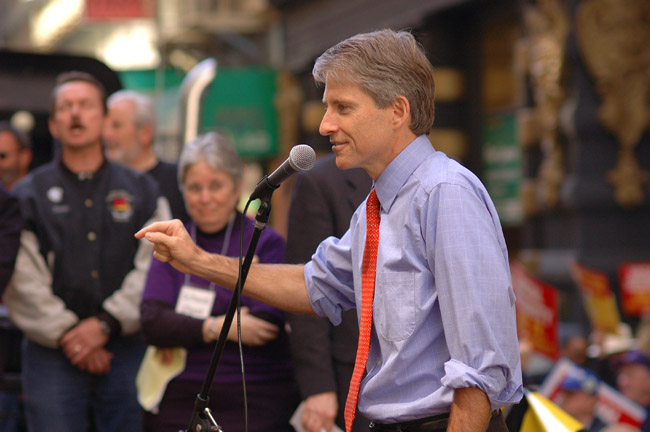
I don't want to come off sounding like a campaign ad, but if you live in California and you believe that Arnold Schwarzenegger should have stayed in Hollywood making movies and not crafting policy in Sacramento, then I suggest you look closer at the Democratic gubernatorial candidate I believe will lead California into the future. That candidate is Steve Westly. Yup, the same Steve Westly who is the present State Controller for the state of California and the same Steve Westly who helped found the online conglomerate, eBay.
The facts and his record speak for itself. Steve is not a career politician. The man could be lying on a hammock in Tahiti overlooking a blue ocean like in those posh Corona ads on television not giving a care in the world about politics and Californians. But no! This Steve Westly actually entered the public arena to make a positive difference for the state of California.
How do you know, you might ask? I spent three days with the man on a bus tour down the heartland of California's Central Valley where unfortunately some of California's poorest reside. Why did Steve visit these people? The answer is quite simple, they're Californians too!
There Steve spoke to hardworking immigrant farm workers, shook hands with concerned community leaders and answered tough questions in non pre-scripted town hall meetings. I found his solutions sensible, pragmatic and optimistic all rolled into one. In immigration, Steve believes that undocumented immigrants are entitled to become citizens but also believes that they must pay their back taxes, learn to speak English, and show commitment to a country that they have come to love.
In education, Steve has a different approach from our current governor. Unlike Arnold who wanted to make teachers easier to fire, Steve believes that teachers are the heroes of public education. “They just need more resources and training to become great teachers,” he said. I can attest to that as a former public high school teacher myself. The problem is not with our first year teachers. Last year Californians showed they understood that very point when they voted against the Governor's teacher tenure initiative.
The problem in education lies in the curriculum and Steve understands that a cookie-cutter approach won't cut it. As such, he advocates for more local control in our school districts and understands that teachers should decide what is best for our students and not Sacramento.
Perhaps his most daunting promise is to make California community colleges free to all students who commit to do the following: earn a two-year associates degree, transfer to a four-year college or earn a vocational degree. While other politicians may make promises and move on without ever explaining how to pay for it, Steve actually described how he'll pay the $158 million cost.
Citing his record as State Controller, Steve told his audiences how he held California's largest companies accountable in paying their fair share in taxes. After a kind letter threatening an audit, the State Controller's office received four hundred checks from California companies amounting to $400 million dollars to fill California's coffers. Simply said, that amount could have paid for free community college tuition for California's deserving students three times over. "It's an investment worth making for California's future," Steve reiterated up and down the valley.
What has Arnold done with community college tuition fees? He's doubled it which forced 180,000 of California students to drop out from community colleges.
Why then should you vote for Steve Westly on June 6? He has a proven track record. He took eBay from a company made up of twenty young people sitting on folding lawn chairs in a one room office to one of the world's most successful online businesses employing over 11,000 employees and millions of online buyers and sellers.
We need a governor who understands California's future from a twenty-first century lens. From my experience as a guest on his campaign, I believe Steve Westly possesses the right vision for California and its people. But as Levar Burton would say in Reading Rainbow, don't just take my word for it, research it yourself. Visit www.Westly2006.com.
Technorati Tags:
California Primary
Friday, April 14, 2006
Worst Case Scenario: Pre-emptive attack on Iran makes no sense
This editorial appeared in the Sacramento Bee on Tuesday, April 11th, 2006. It summarized my sentiments about the brewing Iran situation.
Is the United States planning to use military force against Iran in the hope of preventing it from developing a nuclear arsenal? The idea seems absurd on its face, given the price Americans have already paid in Iraq and the likelihood that a new war would only worsen a bad situation in the Middle East.
Yet both the Washington Post and Seymour Hersh, writing in the New Yorker, report that the Bush administration is studying military options. Hersh also says that using tactical nuclear weapons to destroy Iran's nuclear facilities is being considered.
There are so many reasons why attacking Iran is premature at best that it's hard to believe the administration would go beyond having a contingency plan for a worst-case scenario. But some analysts believe it would.
It would be reckless to use military force barring evidence of a greater threat than is now apparent. While Iran continues to defy international demands to stop enriching uranium (now President Mahmoud Ahmadinejad claims they have enriched enough uranium to power a small nuclear reactor), widespread fears that it plans to build nuclear weapons, while well grounded, do not justify pre-emptive war.
President Bush says he still favors diplomacy and calls the media reports "wild speculation." One must hope that's true. Iran is a more formidable adversary than Iraq was. It could unleash terrorist groups in Iraq and in the Palestinian territories; it could cut off oil exports and block the Strait of Hormuz to other Persian Gulf countries' exports, sending already high oil prices soaring; its hard-line regime could use a U.S. attack to stir up nationalist sentiment and crack down on domestic reformist elements; and while bombing Iran's nuclear plants might set back its presumed weapons program, such a strike would be unlikely to end it if Iranian leaders are as determined as U.S. leaders believe them to be.
By attacking, the United States would assume a burden that would be very costly in every sense, provoking political turmoil in an election year. It might also deal a serious blow to relations with America's principal ally, Britain, whose foreign secretary says a military attack against Iran would be "completely nuts."
Some critics say they believe Bush and key aides, despite the setbacks in Iraq and the resurgence of anti-Western forces in Afghanistan, remain in a state of denial. They cite a recent administration National Security Strategy document, for example, that calls Iran the most serious threat to U.S. security. Against that, one must hope that the president, as he says, remains committed to a diplomatic course. Indeed, it's conceivable that the stories were generated by dissident Pentagon and other officials seeking to put the White House on the defensive.
A diplomatic solution to the clash of wills over Iran's nuclear program will not be easy. Russia and China, who have veto power in the United Nations Security Council, strongly oppose both the use of force and tough sanctions against Tehran.
Still, the worst thing the United States could do now is to launch another war of choice that is likely to worsen, not improve, U.S. security and standing in the world. Military contingency plans are a prudent option. But going beyond that in the absence of a clear and present danger would compound mistakes already made, inflame opposition to Bush at home and possibly destroy what's left of the coalition of the willing mustered against Iraq.
Technorati Tags:
Iran
Is the United States planning to use military force against Iran in the hope of preventing it from developing a nuclear arsenal? The idea seems absurd on its face, given the price Americans have already paid in Iraq and the likelihood that a new war would only worsen a bad situation in the Middle East.
Yet both the Washington Post and Seymour Hersh, writing in the New Yorker, report that the Bush administration is studying military options. Hersh also says that using tactical nuclear weapons to destroy Iran's nuclear facilities is being considered.
There are so many reasons why attacking Iran is premature at best that it's hard to believe the administration would go beyond having a contingency plan for a worst-case scenario. But some analysts believe it would.
It would be reckless to use military force barring evidence of a greater threat than is now apparent. While Iran continues to defy international demands to stop enriching uranium (now President Mahmoud Ahmadinejad claims they have enriched enough uranium to power a small nuclear reactor), widespread fears that it plans to build nuclear weapons, while well grounded, do not justify pre-emptive war.
President Bush says he still favors diplomacy and calls the media reports "wild speculation." One must hope that's true. Iran is a more formidable adversary than Iraq was. It could unleash terrorist groups in Iraq and in the Palestinian territories; it could cut off oil exports and block the Strait of Hormuz to other Persian Gulf countries' exports, sending already high oil prices soaring; its hard-line regime could use a U.S. attack to stir up nationalist sentiment and crack down on domestic reformist elements; and while bombing Iran's nuclear plants might set back its presumed weapons program, such a strike would be unlikely to end it if Iranian leaders are as determined as U.S. leaders believe them to be.
By attacking, the United States would assume a burden that would be very costly in every sense, provoking political turmoil in an election year. It might also deal a serious blow to relations with America's principal ally, Britain, whose foreign secretary says a military attack against Iran would be "completely nuts."
Some critics say they believe Bush and key aides, despite the setbacks in Iraq and the resurgence of anti-Western forces in Afghanistan, remain in a state of denial. They cite a recent administration National Security Strategy document, for example, that calls Iran the most serious threat to U.S. security. Against that, one must hope that the president, as he says, remains committed to a diplomatic course. Indeed, it's conceivable that the stories were generated by dissident Pentagon and other officials seeking to put the White House on the defensive.
A diplomatic solution to the clash of wills over Iran's nuclear program will not be easy. Russia and China, who have veto power in the United Nations Security Council, strongly oppose both the use of force and tough sanctions against Tehran.
Still, the worst thing the United States could do now is to launch another war of choice that is likely to worsen, not improve, U.S. security and standing in the world. Military contingency plans are a prudent option. But going beyond that in the absence of a clear and present danger would compound mistakes already made, inflame opposition to Bush at home and possibly destroy what's left of the coalition of the willing mustered against Iraq.
Technorati Tags:
Iran
Wednesday, April 05, 2006
Coming to Public Judgment on Illegal Immigration
At a time when there is public outcry for a serious debate on the issue of illegal immigration, the problem in holding a thoughtful discussion on the issue is that it is so complex, so multi-faceted, can be framed from so many different angles, that it becomes muddled from the very beginning of the conversation. Couple the discussion with a partisan debate and it becomes even murkier.
In Daniel Yankelovich’s landmark book, Coming to Public Judgment, he discusses that democracy can work only if people have wrestled with the issue inside and out. In this immigration debate, the American public has not yet solidified a national consensus needed to cope with this issue. In a sentence: The American public has still yet to achieve public judgment. While I believe that most people understand the context of the issue, most have still yet to fully comprehend the consequences of their opinions. This stems either from not fully knowing the implications of their opinions or from their inability to reconcile their values.
Coming to public judgment is a normative process. Yankelovich defines “public judgment” as
“[P]ublic opinion that exhibits (1) more thoughtfulness, more weighing of alternatives, more genuine engagement with the issue, more taking into account a wide variety of factors than ordinary public opinion as measured in opinion polls and (2) more emphasis on the normative, valuing, ethical side of questions than on the factual, informative side.”
While I admit that I still have yet to come to public judgment, it is evident as I listen to NPR and other radio talk shows that I am not alone: the American public is also presently struggling with this process.
With this definition in mind, solidifying public judgment on the issue of illegal immigration can only be determined by the values one holds and weighing the consequences to these questions:
In Daniel Yankelovich’s landmark book, Coming to Public Judgment, he discusses that democracy can work only if people have wrestled with the issue inside and out. In this immigration debate, the American public has not yet solidified a national consensus needed to cope with this issue. In a sentence: The American public has still yet to achieve public judgment. While I believe that most people understand the context of the issue, most have still yet to fully comprehend the consequences of their opinions. This stems either from not fully knowing the implications of their opinions or from their inability to reconcile their values.
Coming to public judgment is a normative process. Yankelovich defines “public judgment” as
“[P]ublic opinion that exhibits (1) more thoughtfulness, more weighing of alternatives, more genuine engagement with the issue, more taking into account a wide variety of factors than ordinary public opinion as measured in opinion polls and (2) more emphasis on the normative, valuing, ethical side of questions than on the factual, informative side.”
While I admit that I still have yet to come to public judgment, it is evident as I listen to NPR and other radio talk shows that I am not alone: the American public is also presently struggling with this process.
With this definition in mind, solidifying public judgment on the issue of illegal immigration can only be determined by the values one holds and weighing the consequences to these questions:
- Have immigrants who have crossed the border illegally broken the law?
- If they broke the law, what is a fair and just punishment?
- Do their actions warrant deportation?
- Are there alternatives to deportation?
- Are they deserving of the American dream?
- Do they benefit the economy by working in jobs that Americans are not willing to supply?
- Do they hurt the economy and burden the American taxpayer by receiving government assistance?
- Do they pay taxes?
- Are they law-abiding people?
In thinking about these questions, coming to public judgment means reconciling one’s values. One has to mull over and carefully weigh the values of freedom, justice, equal opportunity, compassion, and integrity when considering these questions.
Since there is no formal mechanism to measure public judgment, we hold our elected officials accountable to provide a solution consistent with the nation’s public demand. It is evident that the proposal offered by Senate Judiciary Committee carefully considered the questions above and offered this happy medium. The provision states:
"Under the McCain-Kennedy plan for the 12 million undocumented workers already in the United States, [these immigrants] can apply for temporary status for six years, must demonstrate past work history, pay a 2 thousand dollar fine, undergo rigorous background and security checks, learn English and American civics, make good on back taxes, and satisfy additional criteria. Then if they wait until everyone already waiting their turn is processed through system they can apply for a green card. It is not amnesty, as opponents of the measure contend; rather it would give immigrants an incentive to come forward and an opportunity to earn legal status."
The same process of introspection applies when considering this proposal.
- In your opinion, do you believe that this proposal could be classified as amnesty?
- Is the two-thousand dollar fine and other conditions adequate punishment?
- What are the implications of this proposal?
- Will this encourage or deter illegal immigration?
According to Yankelovich, if one understands what is at stake, does not waver in opinion and achieves consistency within an issue, then one can declare that he or she has achieved public judgment. Only when we have reconciled our values and in thinking and re-thinking our perspectives on an issue will we be able actively advance the democratic process, confident that in the end that we will make sound policy.
___________________
Recommended Reading
Daniel Yankelovich, Coming to Public Judgment. New York: Syracuse UniversityPress: New York, 1991.
Technorati Tags:
Subscribe to:
Posts (Atom)